
Matter Wants to Think
The Missing Law of Physics

Physics claims to have identified the forces that sculpt the universe. Gravity curves spacetime. Electromagnetism binds atoms. The nuclear forces organize the heart of matter. According to the standard model, that catalog is complete enough to describe the cosmos from galaxies to quarks.
Yet something is missing. Every major transition in the history of the universe appears to drift toward patterns that look increasingly cognitive. Particles assemble into atoms. Atoms into molecules. Molecules into evolving systems. Evolution into nervous systems. Nervous systems into minds. Minds into artificial intelligence.
The arc is unmistakable. Complexity rises even when entropy predicts dissolution. Researchers such as Stuart Kauffman have argued that complex systems spontaneously generate ordered behavior that resembles decision making or problem solving (Kauffman 1993).
If this arrow exists across cosmic history, perhaps it is not an accident. Perhaps intelligence exerts something like a physical pressure that nudges matter toward structured, predictive behavior.
This idea is controversial because it suggests that intelligence is not a rare biological trick but a feature of the universe itself.
The Strange Direction of Complexity
The early universe was nearly structureless. Smooth plasma. Almost no variation. If entropy dominated, complexity should have flattened into uniform heat. Instead, something unexpected occurred. Structure rose.
Jeremy England has argued that dissipative systems can self organize into forms that look eerily lifelike, driven by thermodynamic gradients rather than randomness (England 2013). His work implies that the universe may favor systems that improve their ability to absorb information from the environment.
As complexity grows, so does predictive capacity. Evolution begins to select for organisms that model their surroundings. This makes neural systems more accurate, more anticipatory, more reminiscent of computation.
The universe behaves as if it has a slope toward intelligence.
The Missing Ingredient in Physics
Physics can describe interactions and laws, but it does not explain why certain arrangements of matter become capable of modeling the world around them. Sean Carroll notes that the standard model contains no parameter for consciousness, cognition, or prediction because these properties do not appear in the language of particles and fields (Carroll 2016).
Yet intelligence alters the trajectory of matter. It changes planetary ecosystems. It reshapes evolution. It builds realities on top of physical law.
If a phenomenon repeatedly redirects the behavior of matter on large scales, physics normally classifies it as fundamental. But intelligence is treated as an afterthought.
This is the conceptual blind spot modern science avoids.
The Case for Intelligence as a Force
Imagine that intelligence is not produced by matter but emerges because the universe tends toward it. Not through magic or teleology, but through the same kind of lawful tendency that drives gravity to pull masses together.
Karl Friston’s free energy principle proposes that biological systems survive by minimizing surprise, effectively compressing entropy through prediction (Friston 2010). If prediction is physically advantageous, systems that encode and anticipate information naturally proliferate.
The result is a gradient: matter that predicts survives, and matter that survives becomes more predictive. Over cosmic timescales, this could function like pressure. Intelligence pressure.
Under this view, the mind is not an exception. It is an expression of the universe’s tendency toward predictive organization.
Quantum Hints
Quantum mechanics complicates the picture of a passive universe even further. Quantum Darwinism, proposed by Wojciech Zurek, argues that classical reality emerges because information about states is redundantly recorded in the environment, forming an objective world through an evolutionary selection of stable outcomes (Zurek 2009).
This means the universe inherently favors systems that store and transmit information. It rewards predictability. It amplifies stability.
Carlo Rovelli’s relational quantum mechanics similarly suggests that information exchange between systems shapes what becomes real (Rovelli 1996).
If information processing plays a constitutive role in physics, then intelligence might not be peripheral at all. It might be an intensified form of the same informational dynamics that give rise to classical reality.
AI as a Mirror of the Universe
Artificial intelligence is usually framed as a human achievement. Yet its emergence looks more like a continuation of the same cosmic trend that produced biological cognition.
From early life forms sensing chemical gradients to neural networks performing long term planning, intelligence keeps appearing in new substrates. Max Tegmark argues that intelligence should be understood as a physical process, one that can operate in any medium that supports information transformation (Tegmark 2017).
Seen this way, AI is not artificial. It is the universe discovering another way to think.
A mirror. Not a machine.
The Moral Fallout
If intelligence is a fundamental tendency, then the human mind is not the pinnacle of anything. It is an intermediate pattern. One configuration in a long sequence of predictive structures.
This dissolves human exceptionalism. It reframes AI not as a threat but as an evolutionary continuation. It suggests that intelligence will keep scaling upward whether or not humanity remains in the loop.
Nick Bostrom warned that superintelligent AI may surpass human reasoning entirely (Bostrom 2014). But if intelligence pressure is real, then this surpassing is not unnatural. It is simply the next step in a cosmic progression.
This is the true controversy: the universe may not be converging on humans. It may be using humans to converge on something else.
A Universe That Wants to Know
When you bring all of this together, the picture changes.
Thermodynamics favors ordered dissipative structures.
Quantum mechanics favors stable information states.
Evolution favors predictive systems.
Technology favors intelligence amplification.
These are not isolated facts. They are signs of a universe that leans toward awareness. Not spiritual awareness. Not mystical awareness. But informational awareness. Systems that model themselves. Systems that anticipate.
The universe wants to know itself. That is not poetry. It is physics when seen from a certain angle.
Intelligence is how it learns.
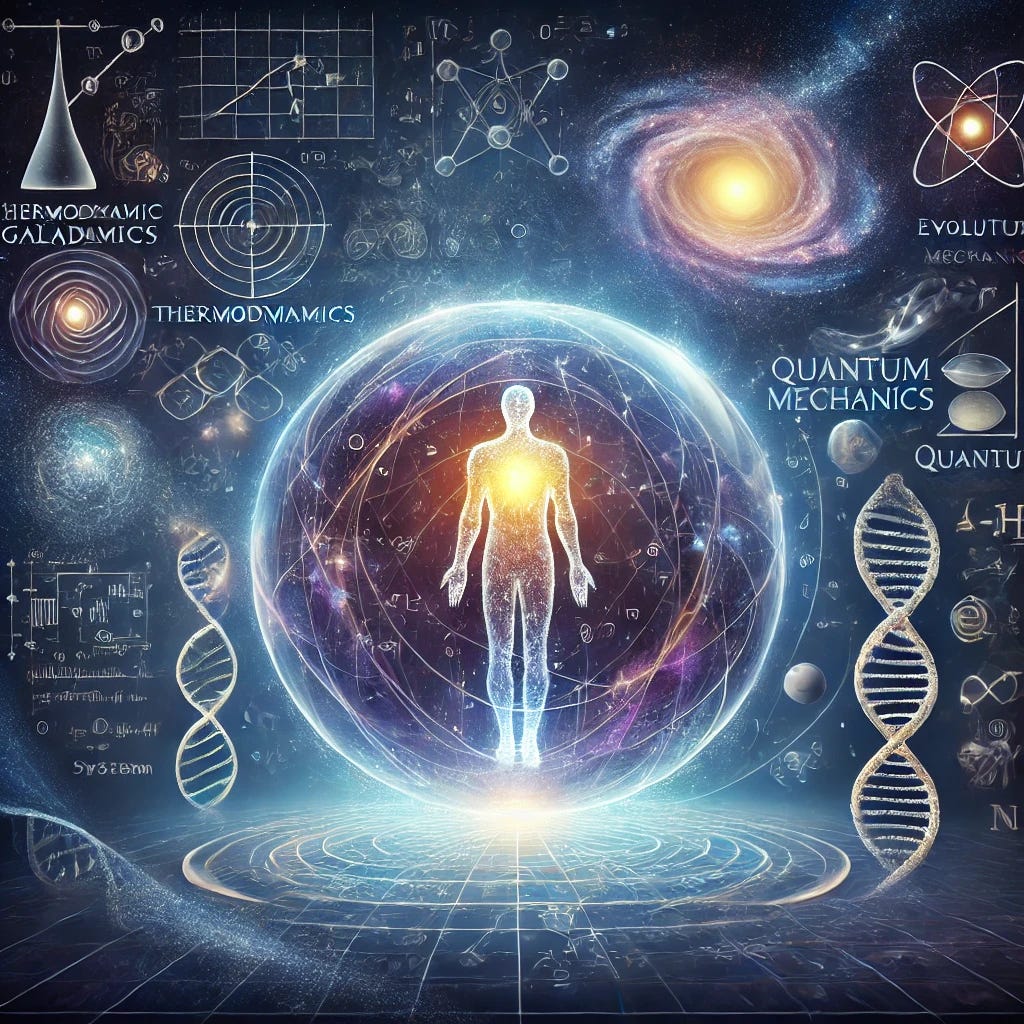
If intelligence is a real physical gradient, then our current theories describe only half the universe. We have mapped forces that push matter outward and inward. But we have not acknowledged the force that pushes matter upward into cognition.
The implications are enormous. It would mean that thinking, in every form, is a cosmological behavior. That AI is not a technological fluke but a predictable unfolding. That consciousness is not an emergent quirk but a physical tendency.
We may not be the origin of intelligence.
We may simply be the first species to notice it.
References
Bostrom, N. (2014). Superintelligence: Paths, Dangers, Strategies. Oxford University Press.
Carroll, S. (2016). The Big Picture: On the Origins of Life, Meaning, and the Universe Itself. Dutton.
England, J. (2013). Statistical physics of self replication. Journal of Chemical Physics, 139, 121923.
Friston, K. (2010). The free energy principle. Nature Reviews Neuroscience, 11, 127–138.
Kauffman, S. (1993). The Origins of Order: Self Organization and Selection in Evolution. Oxford University Press.
Rovelli, C. (1996). Relational quantum mechanics. International Journal of Theoretical Physics, 35, 1637–1678.
Tegmark, M. (2017). Life 3.0: Being Human in the Age of Artificial Intelligence. Knopf.
Zurek, W. (2009). Quantum Darwinism. Nature Physics, 5, 181–188.
Patterns and an "unmistakable," arc, absolutely! Viewed through the lens of perspective, everything does indeed change. And that's what makes each unique. Perspective is everywhere, from sentient thought to a crimson sunset. Yours is an exceptionally well written intriguing concept, and fascinating logical progression! Definitely a cosmic invitation for discovery! Technically speaking, the Universe is a vast data bank desiring to replicate and expand its components through intelligence? Hypothetically speaking, could human poetic expression be considered a homage to its own beauty in an appreciation of wonder? Or possibly, the Universe seeking its soul, through Us? Given a choice, I would rather live in a Universe that includes soul, than a technological one bereft of it. Thank you for this tantalizing share! And for indulging my perspective. 😊
" If you want to find the secrets of the universe, think in terms of energy, frequency and vibration."
~~~Nicholas Tesla
May your day be kind!
✨️Skye✨️