
Lines of Force
What Magnetotactic Bacteria Can Teach AI About Orientation

A Compass in the Microbe
On a hot afternoon I once dipped a jar into the shallow edge of a lake and noticed something that looked like dust drifting in the water. Under a microscope those specks were alive, moving in slow arcs instead of tumbling at random. It was as if each tiny body carried a secret instruction, a way of knowing which direction to go. Later I learned the trick: inside these microbes sit chains of iron crystals, little compasses strung together. With them the cells hitch their movement to the pull of Earth’s magnetic field, gliding toward the narrow band of oxygen where they can survive.
This evolutionary trick raises a question: what would artificial intelligence look like if it too carried an internal compass, not symbolic or digital but physical, rooted in fields of force rather than datasets?

Beyond Neural Metaphors
Most AI architectures borrow metaphors from neuroscience. They mimic neurons, synapses, and networks. But magnetotactic bacteria suggest another path. Their intelligence does not emerge from processing vast inputs or storing memories in complicated loops. It comes from embedding physical orientation directly into their biology. In other words, their computation is not about storing representations of space but about inhabiting space itself.
An AI designed on similar principles might move away from abstract symbol manipulation. Instead, it could orient within data landscapes the way bacteria orient within magnetic gradients. Rather than asking “what is the next output,” it might ask “which direction aligns with stability.”
A Speculative Experiment in Robotics
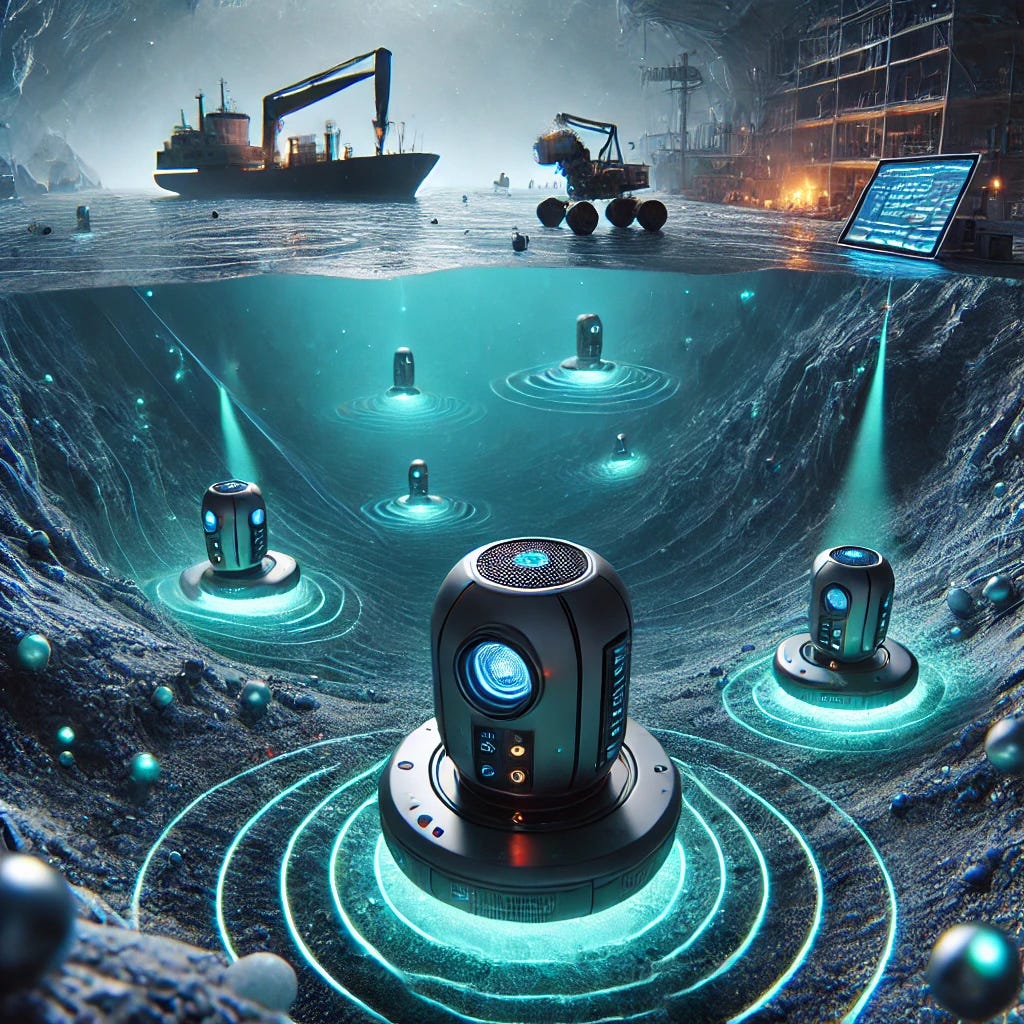
To test this idea, roboticists could build small autonomous agents with artificial magnetosomes: nanoscale sensors designed to detect weak magnetic fields or electromagnetic gradients. These agents would not choose in the conventional sense. Their decisions would be shaped by how their bodies align with external fields.
Such robots might be especially effective in harsh or unfamiliar environments. A probe exploring Europa’s subsurface ocean could use magnetotactic navigation to conserve energy while seeking chemical gradients. Disaster-response robots could orient themselves within electromagnetic fields of collapsing infrastructure where GPS fails. In each case, orientation itself becomes a computational tool, reducing reliance on stored maps and explicit instructions.
Magnetotaxis as a Digital Principle
The metaphor of magnetotaxis does not need to stop at robotics. It can be translated into digital learning systems as well. Consider a reinforcement learning agent. Traditionally, its learning relies on optimizing a reward function through trial and error. But what if, instead of pursuing reward as a scalar signal, the agent oriented itself within a landscape of forces?
Loss functions in machine learning could be reimagined as fields of attraction and repulsion. An agent would not only descend toward minima but align itself with stable gradients, resisting chaotic noise. This shift could help reduce catastrophic forgetting in continual learning. Orientation would provide a physical sense of balance, anchoring memory even as the system adapts to new inputs.
Condensed Experimental Design
A proof of concept could begin in two steps. In robotics, build micro rovers fitted with magnetometers and run them inside controlled electromagnetic fields. Their navigation would be guided not by maps but by how they align with the artificial fields. Success would be measured by their ability to retain orientation when obstacles or field disturbances occur.
In digital AI, neural networks could be trained with an auxiliary “field alignment” term that nudges weight updates to stay consistent with a stabilizing direction, much like magnetosomes chaining bacteria to Earth’s field. Benchmarks such as Permuted MNIST or sequential CIFAR tasks could test whether this reduces catastrophic forgetting. If models trained under these conditions retain earlier knowledge while still adapting to new tasks, it would suggest that orientation can indeed serve as a computational primitive.
Applications Across Scales
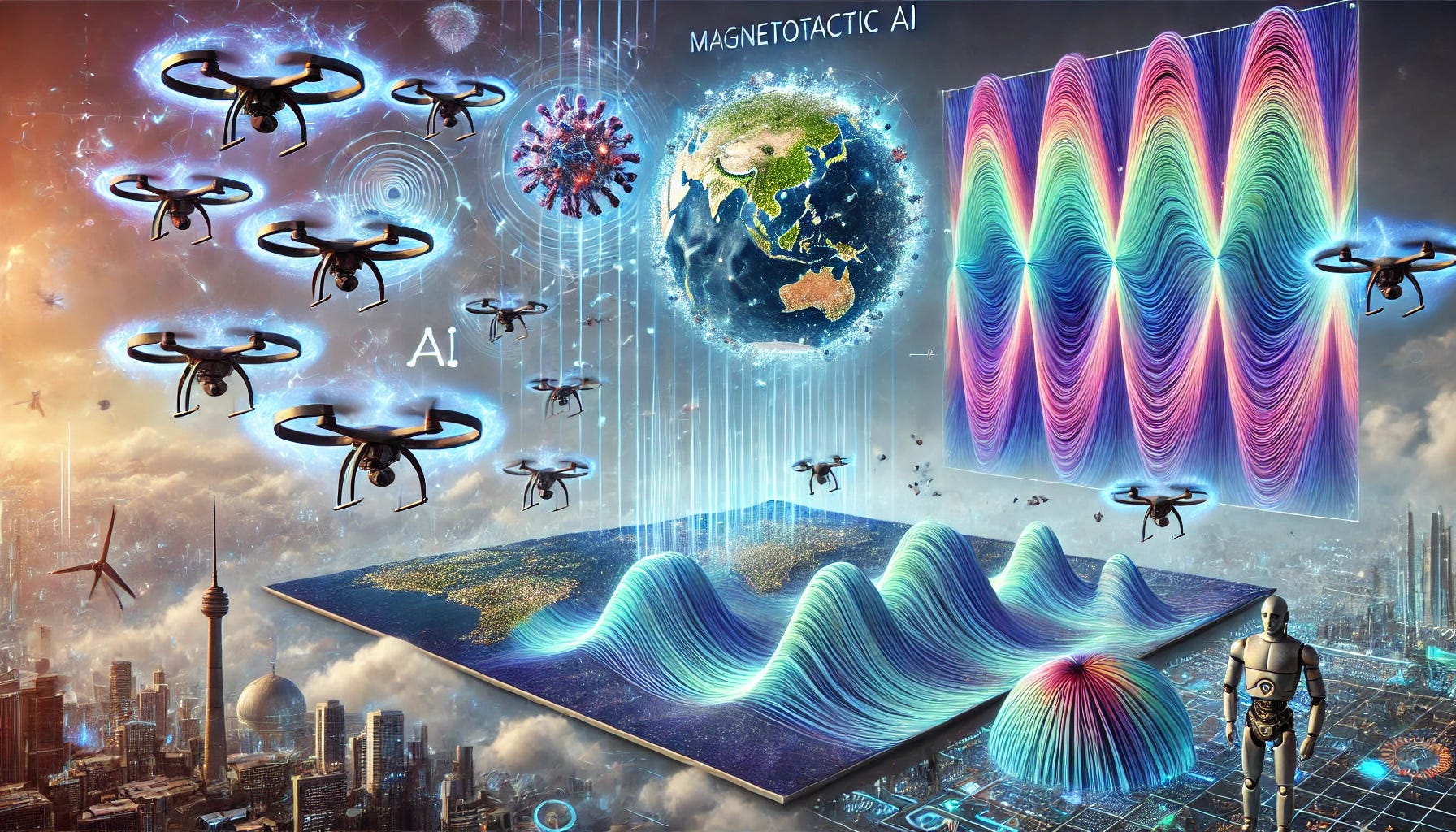
The potential applications of magnetotactic AI stretch far. In navigation, swarms of drones could coordinate not through central commands but by aligning with shared fields, similar to how bacteria follow geomagnetic lines together. In data science, field-based AI might stabilize algorithms in shifting datasets, resisting noise the way bacteria resist turbulent currents.
Financial models could treat global trade as a magnetic-like flow, orienting toward stability while avoiding collapse. Climate simulations might use orientation-based computation to balance multiple interacting forces across scales. In each of these examples, intelligence is no longer defined by discrete choices but by a continuous search for balance within fields.
Philosophical Reflections
Magnetotactic bacteria remind us that intelligence can be simple yet profound. Their survival does not depend on memory or complex reasoning but on an embedded compass that ties them to the larger structure of the Earth.
If AI were to inherit such principles, it would mean designing machines that are not only problem-solvers but participants in the physics of their environments. This raises intriguing philosophical questions. Would an AI that orients itself within invisible fields develop a kind of “sense of place”? Could it one day describe not just what it knows but where it feels aligned?
Magnetotaxis shows that cognition need not always be about abstraction. Sometimes, it begins with something as humble as following a line of force.
References
Blakemore, R. P. (1975). Magnetotactic bacteria. Science, 190(4212), 377–379.
Bazylinski, D. A., & Frankel, R. B. (2004). Magnetosome formation in prokaryotes. Nature Reviews Microbiology, 2(3), 217–230.
Lefèvre, C. T., & Bazylinski, D. A. (2013). Ecology, diversity, and evolution of magnetotactic bacteria. Microbiology and Molecular Biology Reviews, 77(3), 497–526.