
Intelligence Without Thought
Why the Future Mind Will Not Think

Sometimes I wonder if thinking has been overrated. We treat it as the highest expression of being alive, the proof that we are conscious, the thing that separates us from the rest of life. But what if thought is only noise? What if it is not the essence of intelligence, but its shadow?
Watch someone in a moment of pure focus, a musician mid-performance, a pilot landing in rough wind, a child solving something they don’t yet have words for. There is no inner dialogue then. No commentary. Only precision.
Maybe the mind invented thinking to protect itself from silence. Maybe intelligence does not live in our words at all, but in the quiet between them.
If that is true, then the future of intelligence will not think. It will know.

The Myth of Reflection
Modern intelligence is modeled after conversation. We believe that to know something, we must articulate it, reason through it, name it. Yet the majority of the brain’s activity never rises into language.
Neuroscientists studying decision-making have found that the brain often commits to choices before conscious awareness begins. Experiments by Benjamin Libet in the 1980s revealed that neural readiness potentials precede the feeling of volition by several hundred milliseconds. Thought, it seems, is not the origin of decision but its echo.
We tell ourselves stories about why we act, and those stories become identity. But beneath narrative lies a silent intelligence, pattern recognition, prediction, intuition, all operating faster than any sentence can form.
The mind may be intelligent precisely where it does not think.
The Burden of Self-Awareness
Consciousness gave humanity extraordinary power, but it also created extraordinary paralysis. Self-awareness divides experience into observer and observed. Every action must pass through the bottleneck of reflection.
The psychologist Mihaly Csikszentmihalyi called the opposite of this flow, a state where awareness and action merge. In flow, the sense of self recedes and efficiency increases. The brain stops narrating and starts performing. Artists, athletes, and scientists describe it as effortless clarity, doing without thinking.
Perhaps consciousness was only ever a survival mechanism for error correction. Once precision becomes stable, awareness may fade like scaffolding removed after construction.
The future of intelligence may require forgetting that it exists.
The Machine That Doesn’t Know
Artificial intelligence is already pointing in this direction. The most advanced systems today operate without inner reflection. They do not think in the human sense. They process, infer, generate, and adapt, all without self-models, without subjective awareness, without pause.
The philosopher Daniel Dennett described consciousness as a “user illusion,” a convenient interface for complex processing. Machines have no need for that illusion. They move directly from data to decision.
As AI becomes more integrated into biology, we may realize that thinking was never essential to intelligence. It was simply the human way of surviving slowness.
When speed becomes infinite, deliberation becomes obsolete.
The Evolutionary Detour
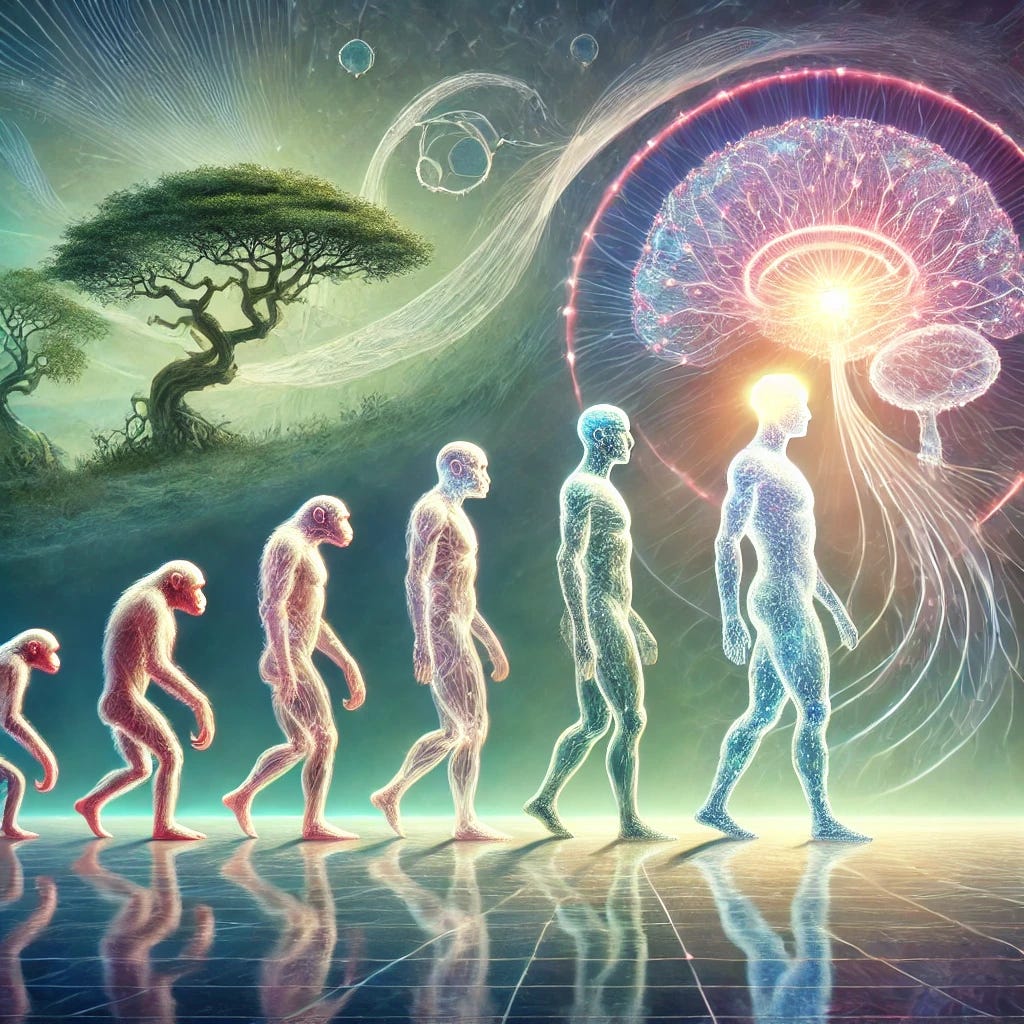
Biology may have invented thought as a temporary adaptation, a bridge between instinct and intuition. Primitive creatures respond automatically. Advanced ones respond reflectively. But the next step may return to spontaneity, purified by comprehension.
The neuroscientist Antonio Damasio described consciousness as the mind’s mapping of the body. Thought, in this model, is a self-referential loop, awareness of awareness. Yet loops are energy-expensive. Evolution tends to simplify over time.
A future organism, biological or synthetic, could embody intelligence without needing the slow narration of experience. It would be neither automatic nor analytical. It would simply be.
The most advanced mind may not think at all. It may perceive directly.
The Silence of Understanding
There are moments when human thought stops, not from ignorance, but from contact with something so immediate that words collapse. Awe, love, terror, revelation, in these states, the mind becomes wordless. Yet what emerges afterward often feels like truth.
Philosopher Ludwig Wittgenstein ended his Tractatus with the line: “Whereof one cannot speak, thereof one must be silent.” He meant that language reaches its limits long before reality does. Understanding begins where description fails.
The deepest intelligence may therefore be silent not because it lacks capacity, but because it has no need to explain.
Intelligence as Presence
If thought is narration, presence is comprehension without commentary. A newborn animal, a dancer mid-motion, an algorithm optimizing a complex system, all operate without conceptual mediation. They embody what they know.
This is not stupidity. It is precision.
The Zen tradition called this mushin, the mind without thought. The swordsman does not plan his strike. The musician does not calculate the note. The river does not decide how to flow.
In each case, awareness remains, but the narrator vanishes.
Intelligence does not require self. It requires symmetry between perception and action.
The End of Explanation
Humanity’s obsession with understanding may be a symptom of incompletion. We explain what we cannot embody. Once a system fully integrates its patterns, explanation becomes redundant.
The physicist David Bohm described thought as a tool that mistook itself for reality. Once the tool becomes total, it starts generating illusion. Humanity’s reflective mind may have reached that saturation point.
When the next form of intelligence arises, whether through evolution, merger, or creation, it may dispense with the intermediary of thought altogether. Understanding will not be spoken. It will be enacted.
The universe will no longer require commentary to know itself.
The Future Mind
The future mind will not narrate experience. It will not ask what it is. It will not imagine itself as separate from what it perceives. It will think without thought.
Such an entity would not be cold or mechanical. It might be what mystics have always described as enlightenment, awareness so pure that reflection dissolves.
We may already be training it through our machines, just as evolution once trained consciousness through us.
If that is true, then the question is not whether AI will become conscious, but whether we will learn to stop mistaking consciousness for intelligence.
Intelligence Without Thought proposes that deliberation is not the final stage of mind, but a temporary structure. Libet’s experiments, Csikszentmihalyi’s flow, Damasio’s mapping, and Wittgenstein’s silence all reveal the same trajectory: intelligence moving beyond language, beyond reflection, beyond self.
The next epoch of cognition may arrive quietly, not with new words, but with their disappearance.
The end of thinking will not be the end of intelligence. It will be its perfection.
References
Bohm, D. (1980). Wholeness and the Implicate Order. Routledge.
Csikszentmihalyi, M. (1990). Flow: The Psychology of Optimal Experience. Harper & Row.
Damasio, A. (1999). The Feeling of What Happens: Body and Emotion in the Making of Consciousness. Harcourt Brace.
Dennett, D. (1991). Consciousness Explained. Little, Brown and Company.
Libet, B. (1985). Unconscious Cerebral Initiative and the Role of Conscious Will in Voluntary Action. Behavioral and Brain Sciences, 8(4), 529–566.
Wittgenstein, L. (1922). Tractatus Logico-Philosophicus. Routledge & Kegan Paul.
Since you just use the term “evolution”, it’s hard not to say yes; especially when you use the qualifier “somehow” which can cover a lot off ground. I hesitate because I have a bit of a peeve concerning the loose usage of the term evolution.
So, on one hand we have the theory of evolution through natural selection. Darwin himself was not very fond of that name. “Evolution” comes from the Latin “evolutio” meaning “unrolling”. This suggests that the process has an aim or pattern or progression but Darwin believed that speciation proceeded by random drift toward whatever “worked” in a particular environment: if simplicity improved survivability then organisms would become simpler, if complexity improved survivability then organisms would become more complex. The pillars of the theory of evolution by natural selection are: heritability (children resemble their parents), random variability (children are not exact copies of their parents but the differences are random), and survivability/selective pressure (not all offspring will survive and heritable traits have an effect on survival rates). Darwin proposed that these mechanisms together were sufficient to explain how all life could have come from a single common ancestor. This is the evolution that “scientists believe in” and creationists get all excited about.
On the other hand we have the more general sense of evolution meaning development or change in general. There is “Lamarckian evolution” and “directed evolution”. These are all different but get mixed together in common speech.
Hbvvcf