

Infinite Money Glitch
The money started moving in circles.
Nvidia sells the chips powering the AI boom. OpenAI needs enormous quantities of those chips.
OpenAI needs enormous data centers. Those data centers cost so much money that somebody has to finance them.
Nvidia has apparently decided that somebody can be Nvidia.
On August 17, Nvidia agreed to provide as much as $105 billion in financial guarantees supporting OpenAI’s 20-year lease at a massive new AI campus being developed by SoftBank-backed SB Energy in Pike County, Ohio. Nvidia is also investing $1.5 billion directly into SB Energy. The campus will exclusively host Nvidia AI compute, and OpenAI will be the customer. (Reuters, August 17, 2026; Nvidia, August 17, 2026)
The obvious joke writes itself.
Nvidia helps finance the infrastructure. OpenAI fills that infrastructure with Nvidia hardware. Nvidia records more demand for Nvidia hardware. Those sales generate more cash that Nvidia can deploy into the next generation of AI infrastructure.
Infinite money glitch.
The actual financial structure is more complicated than Nvidia handing Sam Altman $105 billion and telling him to go GPU shopping.
Nvidia is becoming part chipmaker, part infrastructure developer, and… part bank.
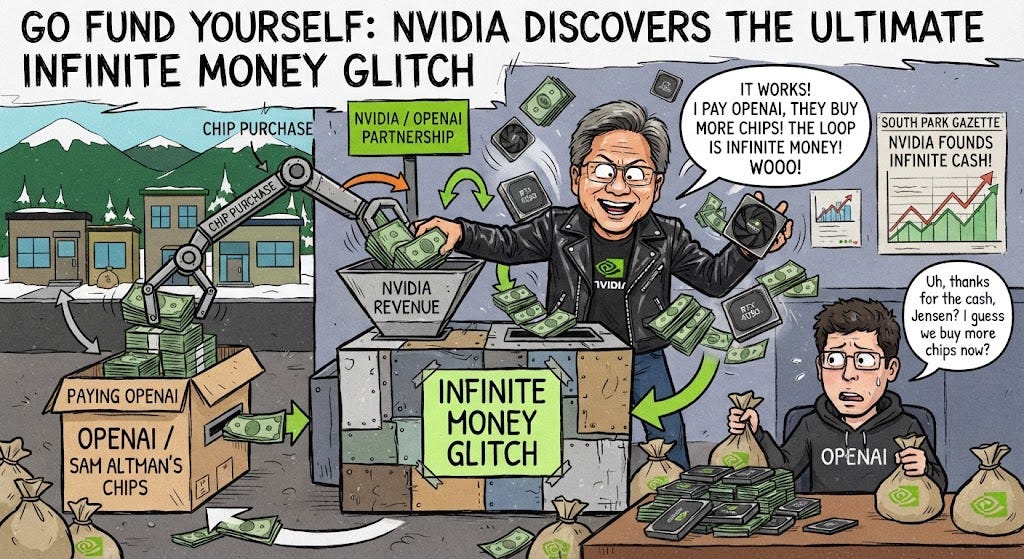
Nvidia Became The Bank
The scale of the Ohio project is difficult to comprehend.
SB Energy plans to build at least 10 gigawatts of new power generation around the site, producing enough infrastructure for 8 gigawatts of AI computing capacity. OpenAI has agreed to use all 8 gigawatts under a 20-year lease. The first capacity is expected to begin coming online in 2028. (Nvidia, August 17, 2026)
Nvidia’s initial credit support covers roughly 4.25 gigawatts, with an option tied to the remaining 3.75 gigawatts. Its guarantees cover defined portions of land, power, lease payments and residual property value rather than the entire cost of the campus. The exposure also declines as OpenAI makes payments and facilities enter service. (Nvidia, August 17, 2026)
Even with those protections, $105 billion is a hilariously large number for a company whose traditional business involved designing computer chips.
And Ohio is only part of the story.
One week earlier, Nvidia announced partnerships with Apollo, BlackRock, Blackstone, Brookfield, Goldman Sachs and KKR to create financing platforms intended to mobilize more than $500 billion in third-party capital for AI infrastructure. Nvidia says these pools will give its customers access to capital at attractive rates and turn Nvidia compute into an investable asset class. (Nvidia, August 10, 2026)
Jensen Huang has effectively identified the next bottleneck.
For years, Nvidia’s problem was manufacturing enough GPUs.
Now the world needs the land, electricity, data centers and hundreds of billions of dollars required to actually deploy them.
So Nvidia is helping solve those problems too.
At What Point Does Nvidia Start Creating Its Own Demand?
This is where things get weird.
Nvidia says OpenAI’s existing and planned deployments represent roughly 12 gigawatts of Nvidia compute through 2030, potentially rising to 16 gigawatts if the Ohio project fully expands. Nvidia estimates that opportunity at roughly $600 billion worth of Nvidia compute. (Nvidia, August 17, 2026)
Six hundred billion dollars.
Nvidia has every reason to make sure those data centers get built.
That creates a fascinating question for anyone trying to measure the actual demand underneath the AI boom:
At what point does Nvidia stop measuring demand and start creating it?
Imagine a customer independently raises $20 billion and spends $10 billion on Nvidia GPUs. That is straightforward demand.
Now imagine Nvidia invests in the infrastructure developer, guarantees parts of the customer’s long-term obligations, helps create financing vehicles that provide capital to the customer, and ultimately becomes the exclusive hardware provider inside the resulting facilities.
The customer still wants the compute. The chips still exist. The workloads still run.
The financial loop simply becomes much tighter.
Nvidia has already expanded this playbook elsewhere. It invested $2 billion in CoreWeave earlier this year while CoreWeave committed to building more than five gigawatts of Nvidia-powered AI infrastructure. And on August 21, Nvidia disclosed another investment in data-center developer Cloverleaf Infrastructure to accelerate additional U.S. AI projects. (CoreWeave, January 26, 2026; Reuters, August 21, 2026)
Nvidia increasingly owns a piece of the ecosystem buying Nvidia.
That may prove to be one of the greatest business strategies ever devised.
It also deserves scrutiny.
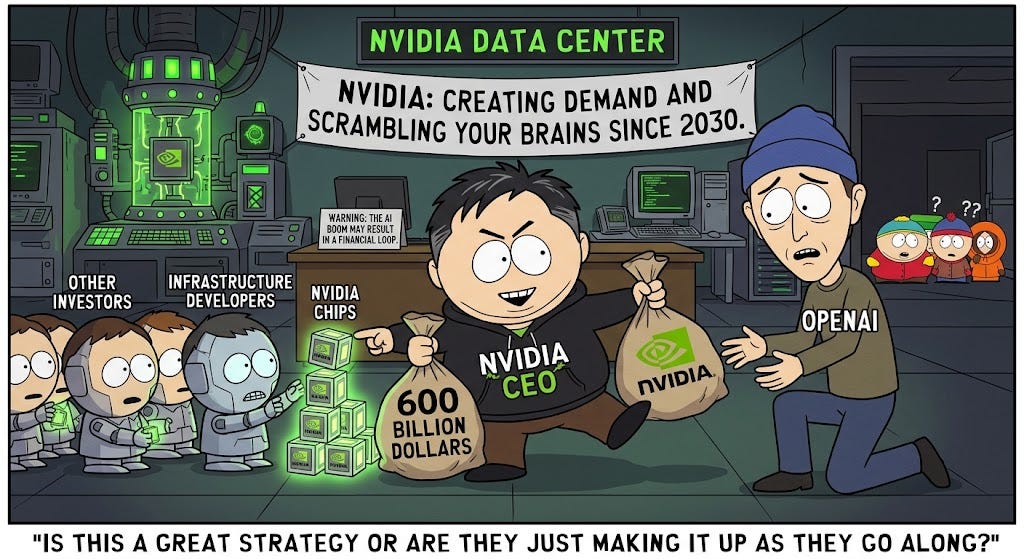
We’ve Seen This Movie Before
There is a name for the general idea: vendor financing.
Companies have financed their own customers for decades. Automakers finance cars. Industrial manufacturers finance machinery. Technology companies have used credit to help customers purchase expensive equipment.
The telecom boom around the year 2000 provides a particularly uncomfortable comparison.
Cisco, Lucent and Nortel competed aggressively to finance telecommunications companies buying their networking equipment. By 2000, Cisco had committed roughly $2.4 billion in customer loans, while Lucent had around $7 billion in financing commitments. The loans helped customers build networks faster and helped equipment manufacturers keep selling hardware. (TheStreet, November 8, 2000)
Then many telecom customers collapsed.
Cisco eventually reserved almost $900 million for bad loans, while billions in vendor financing across the industry were written down as telecommunications companies went bankrupt. (Los Angeles Times, May 25, 2003; CFO, March 1, 2003)
The AI boom is structurally different in plenty of ways. Nvidia is enormously profitable. Demand for AI computing remains strong. The Ohio guarantees contain safeguards, and Nvidia argues that the infrastructure could be reassigned to another tenant if OpenAI eventually stops using it.
Still, history gives us a useful rule.
Financing your customers works wonderfully while the customers keep paying.
The risk appears when everybody discovers that projected demand and realized demand were two different things.
The Bet Behind The Bet
Nvidia clearly believes that problem will never become large enough to matter.
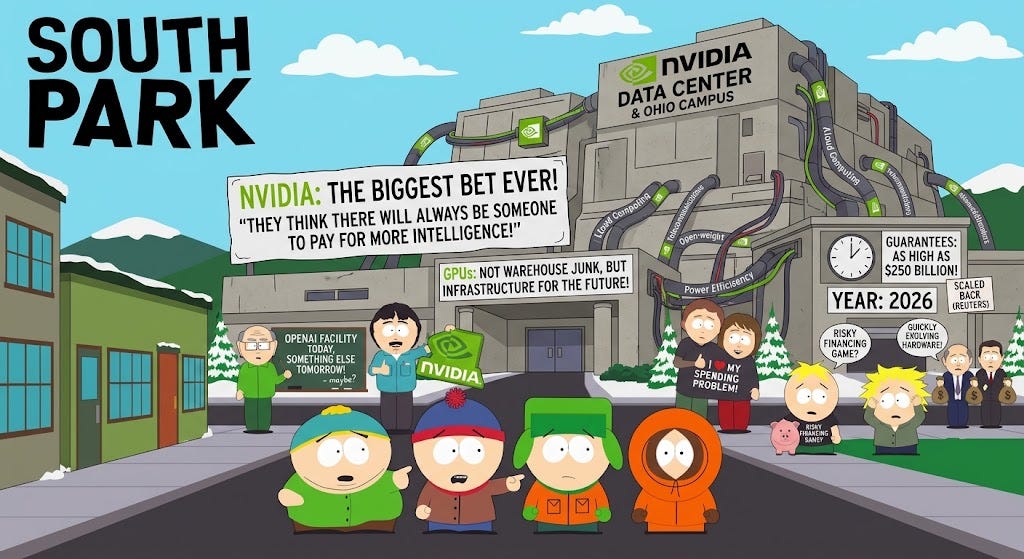
Its argument is straightforward: AI compute will become infrastructure on the scale of electricity, cloud computing or telecommunications. Nvidia GPUs can serve many customers and workloads. Data centers can repeatedly replace old hardware with newer generations. An OpenAI facility today could theoretically become somebody else’s facility tomorrow.
Nvidia therefore views the Ohio campus as a long-lived productive asset rather than a giant warehouse permanently attached to one customer.
That assumption matters.
AI hardware evolves incredibly quickly. Today’s flagship GPU can become yesterday’s hardware within a few product cycles. Power efficiency improves. Models become cheaper to run. Competitors build alternative accelerators. Open-weight models continue squeezing more capability out of less compute.
Meanwhile, the financial obligations attached to the physical infrastructure can last for decades.
Wall Street has noticed the tension. Reuters Breakingviews warned last month that Nvidia was being drawn into a risky financing game as increasingly expensive AI infrastructure pushed customers toward debt and guarantees. The earlier version of the Ohio proposal reportedly contemplated guarantees as high as $250 billion before the final arrangement was scaled back. (Reuters Breakingviews, July 27, 2026; Reuters, August 17, 2026)
Nvidia’s entire strategy rests on one enormous assumption:
There will always be somebody willing to pay for more intelligence.
So far, that has been a spectacular bet.
Welcome To The Nvidia Economy
Not too long ago, Nvidia just sold GPUs.
Then it sold entire AI systems.
Now it is investing in AI labs, cloud providers, data-center developers and energy infrastructure while assembling Wall Street financing platforms funneling hundreds of billions of dollars into AI compute.
Nvidia is building an economic moat around itself.
And you can see why.
The biggest threat to Nvidia’s growth may come from the sheer amount of money required to continue buying Nvidia products. If the next generation of AI infrastructure costs hundreds of billions of dollars, Nvidia has more incentive than almost anyone on Earth to make sure that capital remains available.
The result is a feedback loop.
Nvidia’s success gives it the balance sheet to finance more AI infrastructure. That infrastructure creates more places to install Nvidia hardware. More Nvidia hardware produces more revenue. More revenue gives Nvidia an even larger balance sheet.
The machine can keep spinning for an incredibly long time if AI demand continues growing.
And maybe it will.
The world may eventually look back at today’s spending and wonder why anybody thought we were building too much.
Still, something fundamental has changed.
Nvidia used to need its customers to believe enough in the future of AI to spend billions of dollars building it.
Nvidia is now wealthy enough to help finance that future itself.
References
Nvidia. “NVIDIA Guarantees SB Energy’s PORTS-Pike Technology Campus in Ohio to Exclusively Host NVIDIA AI Compute.” August 17, 2026.
Nvidia. “Securing the Infrastructure of Intelligence.” August 17, 2026.
Reuters. “Nvidia to provide up to $105 billion guarantee for OpenAI’s Ohio data center.” August 17, 2026.
Nvidia. “NVIDIA Partners With Apollo, BlackRock, Blackstone, Brookfield, Goldman Sachs and KKR to Establish AI Compute Infrastructure Financing Platforms to Mobilize Over $500 Billion of Third-Party Capital.” August 10, 2026.
Reuters Breakingviews. “Cloudmaxxing sucks Nvidia into dangerous game.” July 27, 2026.
CoreWeave. “NVIDIA and CoreWeave Strengthen Collaboration to Accelerate Buildout of AI Factories.” January 26, 2026.
Reuters. “Nvidia invests in data center developer Cloverleaf Infrastructure.” August 21, 2026.
TheStreet. “Cisco, Lucent and Nortel: Prime Lenders for the Network Buildout.” November 8, 2000.
Los Angeles Times. “Putting a Spotlight on Cisco’s Lending.” May 25, 2003.
CFO. “What Goes Around.” March 1, 2003.