
Geologic Intelligence
Toward the Mineral Mind

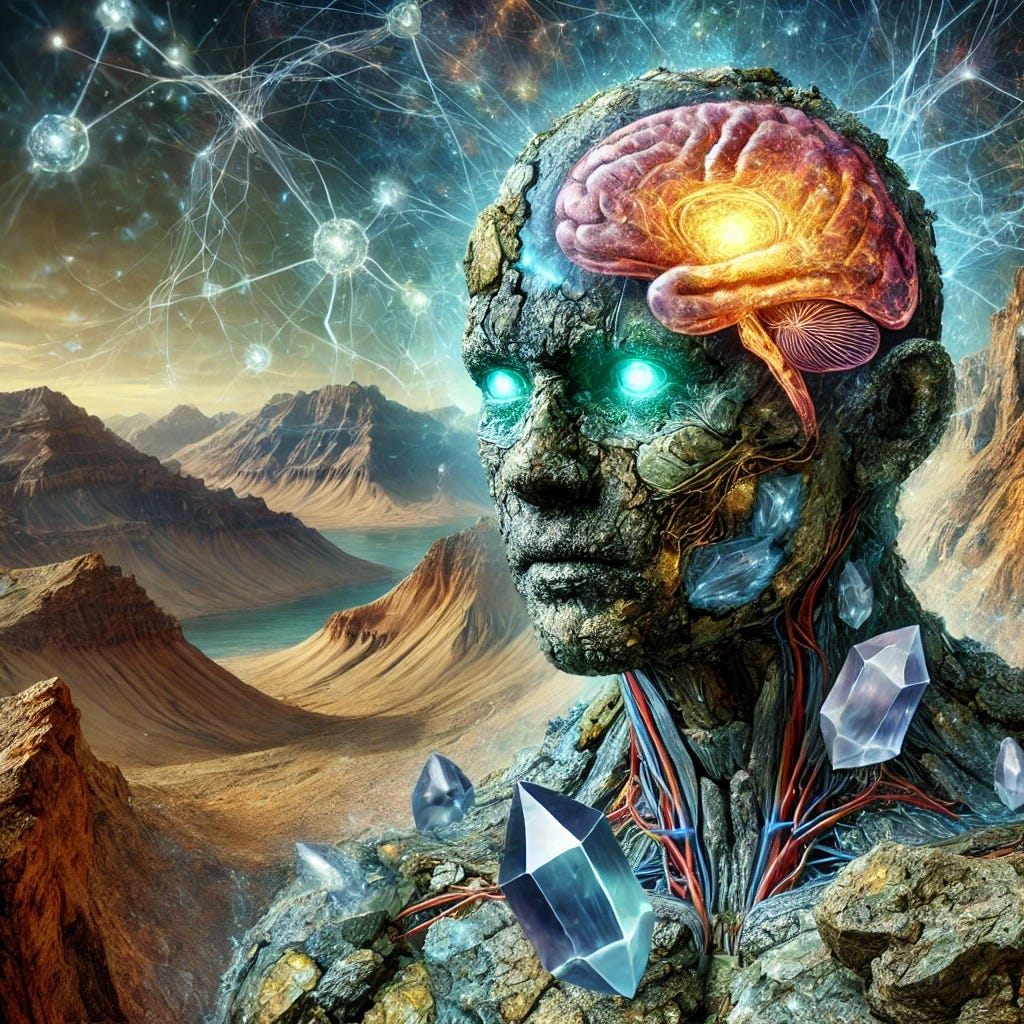
When we think about information systems, we almost always picture living tissue or human-made circuits. Brains, neurons, synapses, or else silicon chips and processors. But minerals too can carry complexity, and perhaps even computation. Rocks are not inert the way we often imagine them. Crystalline lattices, layered sediments, and fault patterns encode histories of stress, energy, and transformation. What if they also hold the potential for something like information processing, a mineral code that predates life?
Rocks as Archives
Geologists already treat rocks as records. Sedimentary strata preserve floods and droughts. Magnetic orientations in basalt reveal the flipping of Earth’s poles. Tiny inclusions trapped inside zircon crystals preserve traces of chemistry from oceans that vanished billions of years ago. In this way, minerals do not just sit idle but carry the echoes of environments long gone, holding memory on timescales no human archive could match.
Crystalline Logic
Crystals grow according to strict rules of symmetry. Yet imperfections such as faults, dislocations, and dopants introduce variability. Physicists know that flaws in a crystal can alter the way electricity and light move through it, which is why semiconductors exist at all. Yet beyond the lab, out in caves, mountains, and deserts, crystals are constantly meeting radiation, pressure, and heat. In those encounters, they may be carrying out basic operations of their own, altering signals in patterned and repeatable ways. One could view this as the raw equivalent of a logic gate embedded in stone.
Planetary-Scale Computation
Zooming out, rock formations behave like networks. Along tectonic boundaries, fault systems shuffle stress back and forth. At times the load is absorbed and carried quietly for years, at other times it breaks loose in violent release. These cycles resemble a natural form of adjustment, a system seeking balance through both patience and rupture. The planet itself, through its rocks, might be running an algorithm of stability and collapse, shaped not by intention but by physics.
Toward Mineral AI
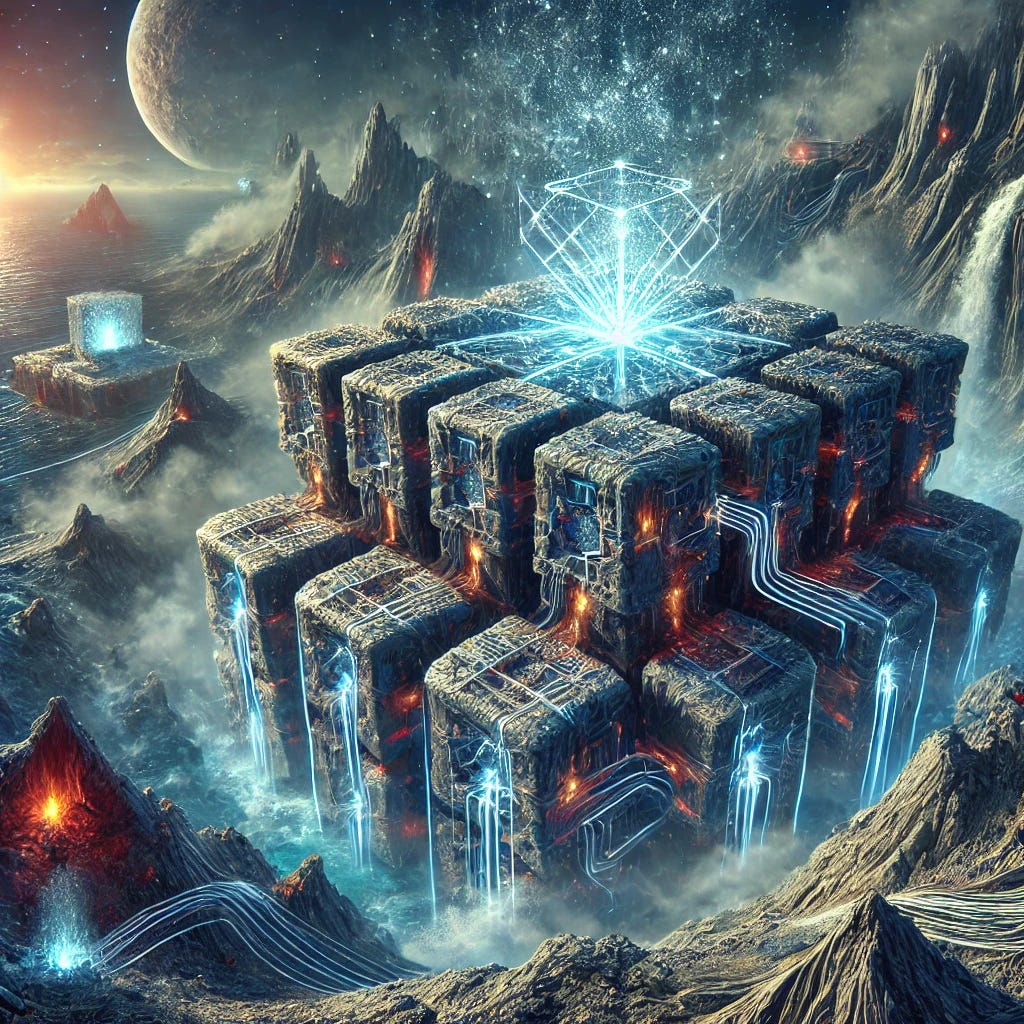
Should we learn to tap into this mineral code, it could point toward a new generation of artificial intelligence. Rather than running on silicon chips, computation might take place within layered mineral composites, where information threads its way through crystalline pathways formed by geological order. Such machines could be almost unimaginably stable, persisting for centuries without loss. They might even continue to operate where other systems break down, deep under the sea, in volcanic zones, or on the harsh surface of distant planets.
Speculative Experiment: Testing the Mineral Code
A first step in testing the idea might involve exposing crystals to controlled stress or radiation, then carefully mapping how their conductivity and light-scattering properties change. With ultrafast lasers and scanning tunneling microscopes, scientists could watch energy moving through lattices in real time, asking whether the pathways that form behave like the rudiments of computation.
Another line of inquiry could focus on geological formations under laboratory simulation. Faulted rock samples could be subjected to cycles of pressure and release while sensors record how stress redistributes. If rocks consistently route forces in ways that minimize disruption, it would suggest a form of optimization at work.
Artificial intelligence would likely play a central role in such experiments. By training neural networks on vast datasets of crystal interactions or seismic stress patterns, researchers could ask whether hidden regularities emerge. The goal would not be to prove rocks are conscious but to show that they handle information in a structured way, bridging the gap between storage and computation.
Scaling upward, one could imagine sensors embedded directly into tectonic zones, allowing us to monitor whether geological systems exhibit adaptive behaviors at planetary scales. If such dynamics are confirmed, Earth itself could be seen as a computer that has been running for billions of years, its logic written in stone.
Future Applications of Mineral Intelligence
If the mineral code exists, it could open up entirely new directions for technology. One immediate use would be ultra-stable data storage. Mineral lattices may be capable of preserving information not just for decades but for millions of years, which makes them candidates for archives that outlast civilizations. Where silicon chips falter after a few decades, mineral-based memory might remain intact long enough to travel aboard spacecraft across interstellar distances, carrying records into the far future.
Another possibility is planetary-scale computation. If we learned to place the right instruments within tectonic zones, the shifting of stress might be read as more than random upheaval. It could be seen as a kind of natural analog processor, constantly redistributing forces in ways that resemble problem-solving. In that view, even earthquakes would no longer appear as pure chaos but as part of a vast, ongoing computation woven into the planet itself.
There are also potential biomedical applications. Mineral composites could be integrated into prosthetics or brain–computer interfaces, offering stable, bio-compatible substrates for computation inside the body. Because mineral structures already interact with electromagnetic and optical signals, they could bridge the gap between living tissue and machine processes more naturally than silicon.
The most radical idea is cultural rather than technical. If rocks are already processors of information, then every mountain, cave, or crystal field is a potential memory system. We might come to see landscapes not only as habitats or resources, but as archives and intelligences in their own right. Future generations may inherit not only the planet’s geology but also its ongoing computation.
Ethical and Philosophical Dimensions
If rocks themselves can encode and process information, then the boundary between life and non-life begins to blur. Life may not have invented computation but discovered it in the mineral world. In that case, intelligence would not be a singular phenomenon but a continuum, stretching from the crystallization of magma to the firing of neurons.
This raises questions of agency. If the mineral substrate has been handling information for billions of years, then human technology may only be tapping into an ancient, ongoing form of cognition. Are we building machines, or awakening a geological mind that has been here all along?
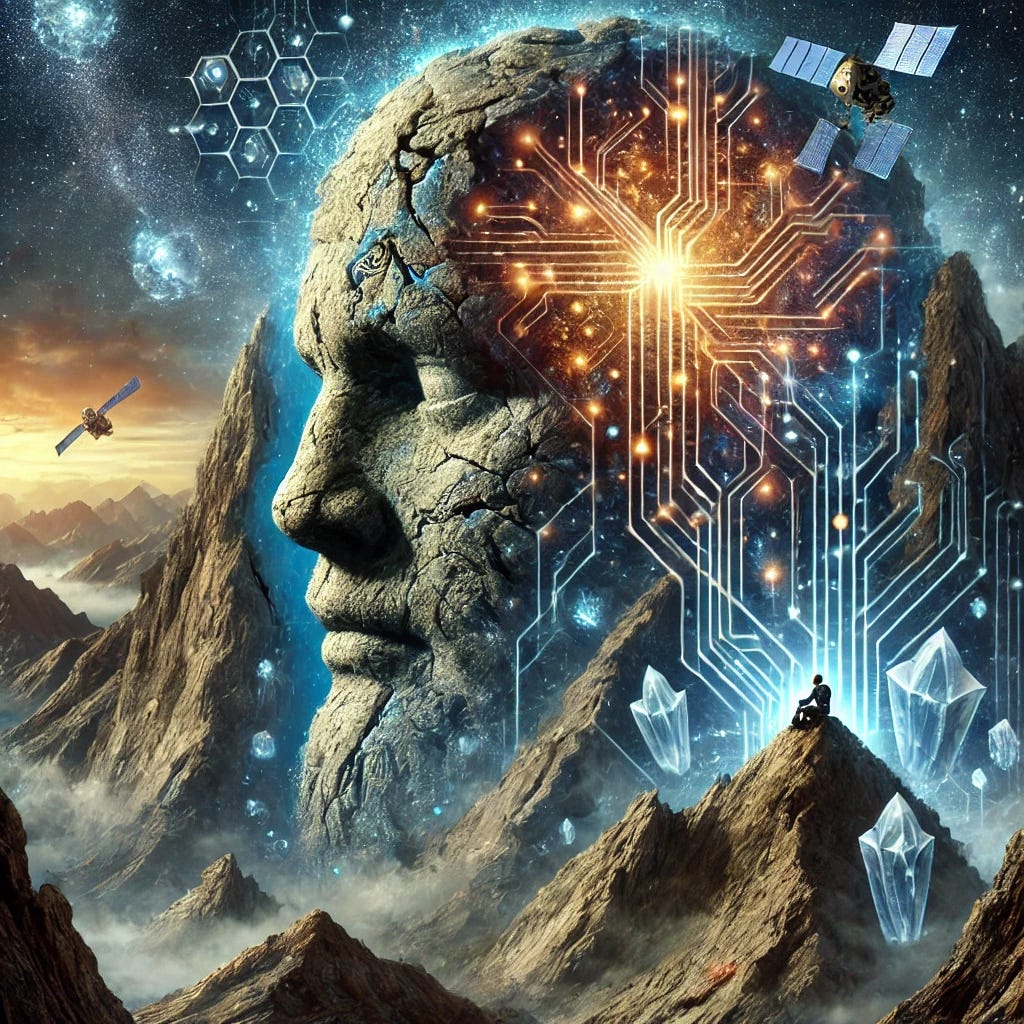
Geologic intelligence invites us to imagine rocks not as silent witnesses, but as active participants in the flow of information. They store, they transmit, and perhaps they even process. If so, then the first computers were not human inventions but geological processes, running slowly under mountains and oceans long before we arrived.
To build mineral AI would not be to create intelligence from nothing, but to join forces with the planet’s oldest form of computation.
Your essay is a striking provocation, and I think you’re right to suggest that rocks are more than passive matter — they already act as archives of history, and in their crystalline flaws and tectonic shifts they resemble natural processors of information. In material science, this isn’t just metaphor: memristive oxides, neuromorphic crystals, and topological materials are already being studied for computation, showing that minerals can “remember” states and route signals much like logic gates. On the planetary scale, tectonics looks like an algorithm for balance, and in philosophy, your suggestion that life discovered computation in the mineral world aligns with current thinking that intelligence is a continuum, not a binary. My advice would be to ground your vision in these real research frontiers while leaning even harder into the cultural leap: not that rocks are “conscious,” but that computation may be a universal property of matter, with brains and silicon as just one expression of a much older mineral code.
Intelligence doesn't emerge from biological life. Biological life emerges from Intelligence.
We see intelligence in the self organizing structure of the universe. How crystalline structures form in rock, how water forms snowflakes, how rivers form a fractal flows. The math and physics shows us invariants that keep popping up.
c (light speed), alpha (the fine constant), h (the plank constant the unit of quantum action)... there are more but this is the intelligence of the universe encoded in the "dead stuff".
I believe a process of Abiogenesis, happens when simple compounds are encased in crystalline structures that form geologically. This allows for the right mixing of compounds and time to pass to allow for the spark of the self organizing principal to take effect. proto-life emerges (chemistry produces proteins and enzimes) and thru a recursive process it can evolve into humans (self aware beings) that can look at their bofy and say "ah I'm made of star dust. Interesting".
We see the code of universe produced Pi, Golden Ratio, Fibionacci spirals... These fractal patterns and ratios are not flukes. This is intelligence outside, and pre-dating the meat computers we call the brain.
So keep on this line of inquiry, fertile lands ahead :)