
Fractal Nutrient Encoding
Can Plants Store Environmental History in Molecular Growth Patterns?

Abstract
This article explores the speculative hypothesis that plants may not simply respond passively to environmental stimuli but actively record these experiences through structured patterns in nutrient allocation and molecular growth. Building on recent studies in isotopic fractionation, plant morphogenesis, and phyllotaxis, we investigate the possibility that plants encode a form of ecological memory in their internal chemical architecture. If validated, this could revolutionize how we study ecosystems, reconstruct historical climates, and interpret biological intelligence across terrestrial and extraterrestrial life.
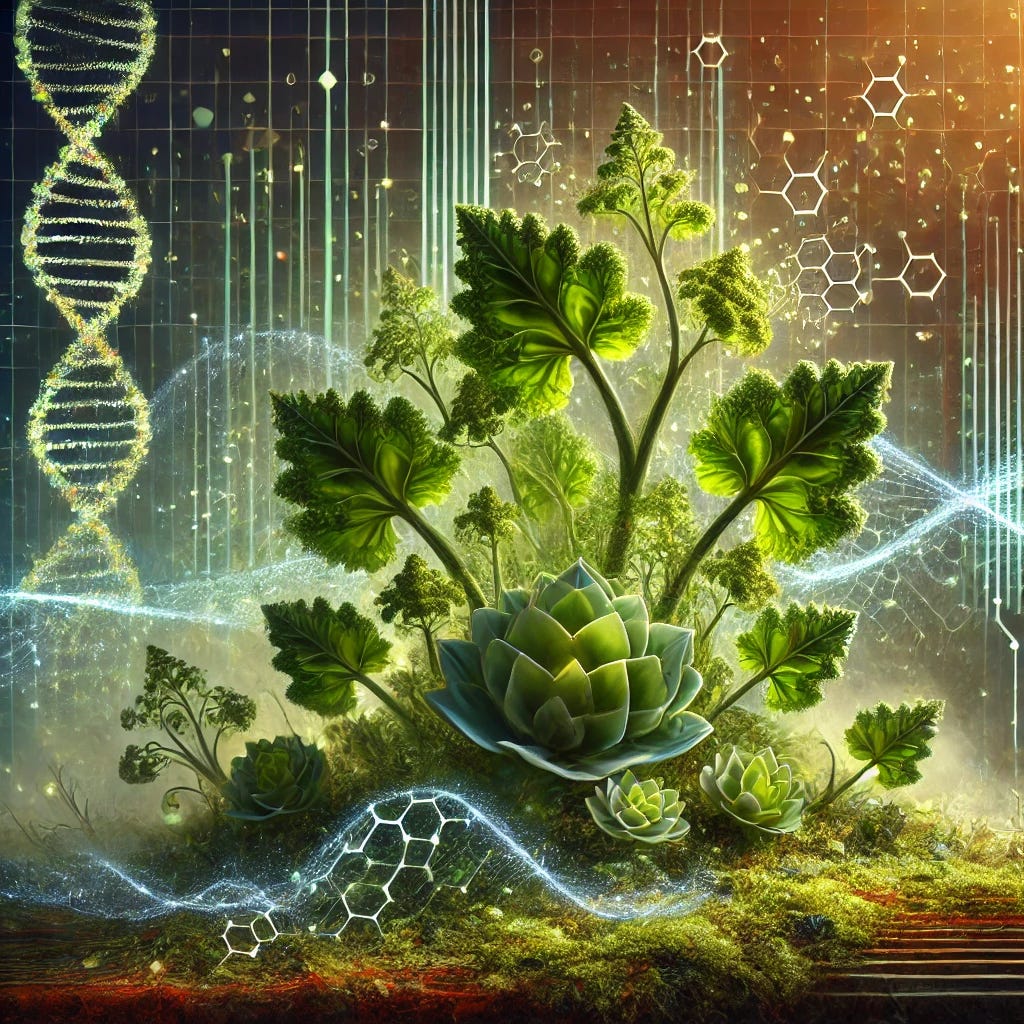
Introduction: Beyond Tree Rings
Traditional approaches to studying environmental history through plants focus on macroscopic features such as growth rings in trees or pollen layering in soil. While these methods provide valuable data, they operate at relatively low resolution and lack insight into short-term or fine-grained environmental changes. Recent developments in mass spectrometry, isotopic analysis, and molecular imaging now allow for exploration at micron and even nanometer scales, revealing spatial complexity in nutrient deposition previously considered noise.
This article hypothesizes that such complexity may not be noise at all but a deliberate encoding system. Specifically, we propose that plants record environmental information in the fractal distribution of minerals, isotopes, and complex biomolecules within their tissue architecture.
Molecular Fingerprinting and Environmental Context
Studies have shown that plants modulate the uptake and storage of elements like nitrogen, phosphorus, magnesium, and trace metals in response to drought, pH, soil salinity, and microbial symbiosis. For example, isotopic ratios such as δ15N and δ13C vary systematically under different stressors (Farquhar et al., 1989). Likewise, heavy metal accumulation in leaves has been used as a proxy for air quality (Kabata-Pendias & Pendias, 2001).
We suggest that the spatial arrangement of these nutrient accumulations, not merely their concentration, may follow emergent, self-similar patterns. This is supported by research on vascular development in plants, which frequently adopts fractal branching geometries (Mandelbrot, 1983; Niklas, 1994). If nutrient storage follows these same patterns, then the chemical landscape of a plant may serve as a high-dimensional record of its environmental exposures.
Fractal Phyllotaxis and Information Density
Phyllotaxis, the arrangement of leaves and other plant organs, often conforms to the Fibonacci sequence and golden angle, enabling optimal light capture and fluid transport. This fractal geometry provides a natural framework for high-density information encoding, analogous to how fractals are used in data compression algorithms.
By aligning environmental response variables with such geometries, plants may effectively "write" a chronological or spatial log of stress, hydration, sunlight exposure, and nutrient flux. Unlike tree rings, which are largely scalar and sequential, this encoding would be spatially distributed and potentially parallel.
This leads to the hypothesis that plant matter, especially vascular and photosynthetic tissues, could be analyzed using multidimensional statistical models or machine learning to decode patterns corresponding to specific environmental histories.
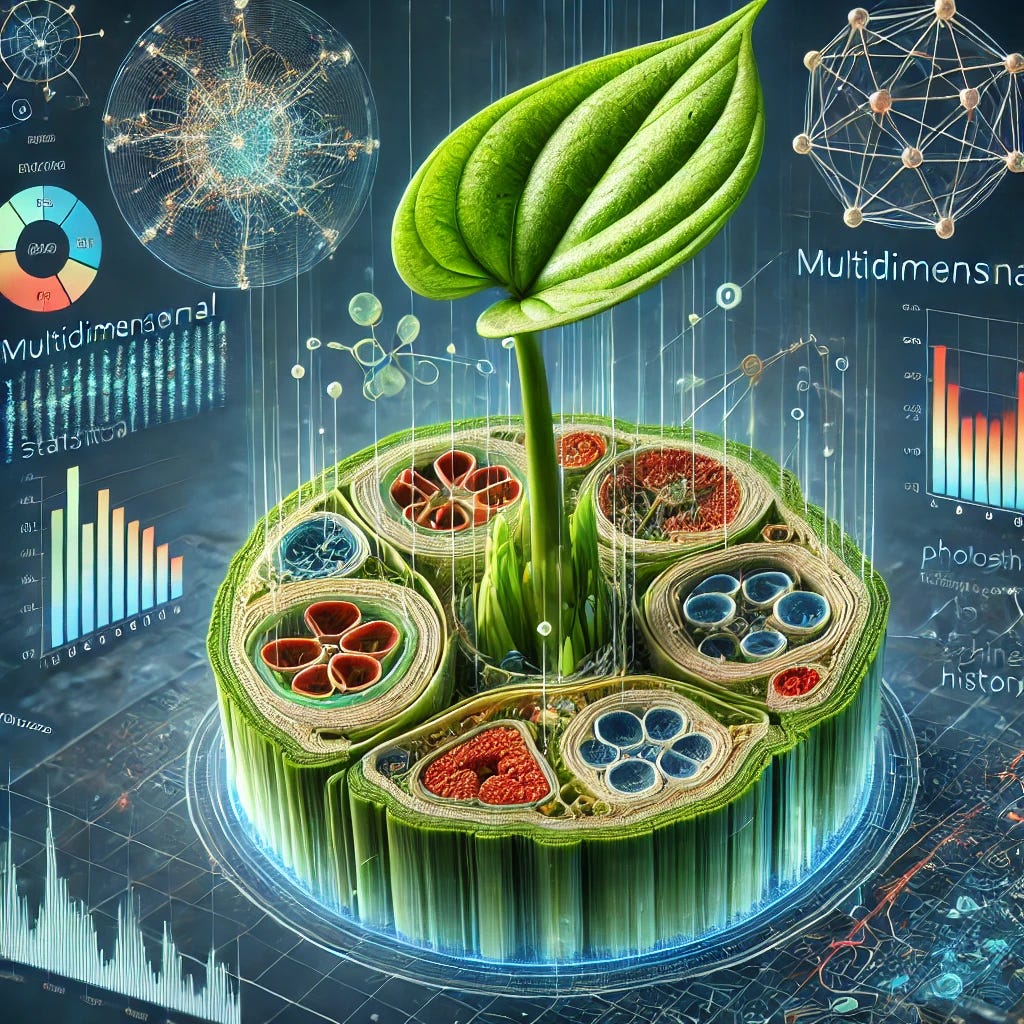
Applications: Biosignature Archives and Ecological Forensics
If fractal nutrient encoding exists, its applications would be vast. For example, climate reconstruction, wherein analyzing ancient or preserved plant tissue at microscale resolution could yield climate data not accessible through rings or sediment layers. In addition, within pollution forensics, spatial maps of heavy metal or toxin distribution within leaves could reconstruct pollution events with temporal precision. Furthermore, farmers could identify past soil health, pest exposure, or drought periods by analyzing crop remnants using agricultural diagnostics. Finally, with regard to astrobiology, if this encoding is a universal feature of life, similar patterns could be sought in alien flora analogs as evidence of sentient or reactive biology.
Philosophical Implications: Plants as Encoders
If plants encode experience through chemical patterns, what does that imply about plant intelligence? Is it enough to say that plants are responsive, or are they actively participating in a biological form of environmental archiving?
This idea resonates with the work of Stefano Mancuso and Monica Gagliano, who argue for distributed cognition in plant systems. It also echoes theories in theoretical biology that propose information is primary, and matter is secondary, that living systems are, above all, information-processing structures (Davies, 2019).
Future Directions and Experimental Proposal
An initial test of this hypothesis would involve subjecting genetically identical plants to different environmental conditions (e.g., varied light, humidity, pollutants) and then using mass spectrometry imaging (MSI), synchrotron X-ray fluorescence (XRF), and Raman spectroscopy to create spatially resolved nutrient maps. Statistical analysis could then determine whether these maps exhibit condition-specific fractal structures.
More ambitiously, machine learning could be trained to classify environmental inputs based solely on chemical imaging data. If the system learns to accurately back-predict the exposure conditions, this will support the existence of a structured encoding system.
Speculative Extension: Synthetic Botanical Sensors
If the principles behind fractal nutrient encoding can be reverse engineered, they may inspire a new class of synthetic biomimetic materials capable of passive environmental sensing and data storage. For instance, engineered microvascular polymers could be designed to absorb and spatially record pollutants, radiation, or humidity variations over time, using mineral deposition patterns to encode data.
These synthetic analogs could be integrated into architectural surfaces, agricultural monitors, or even planetary probes that require zero-power, long-term recording of environmental change. This would mark a convergence between botany, materials science, and computational biology, wherein synthetic "plants" archive environmental history autonomously through pattern formation.
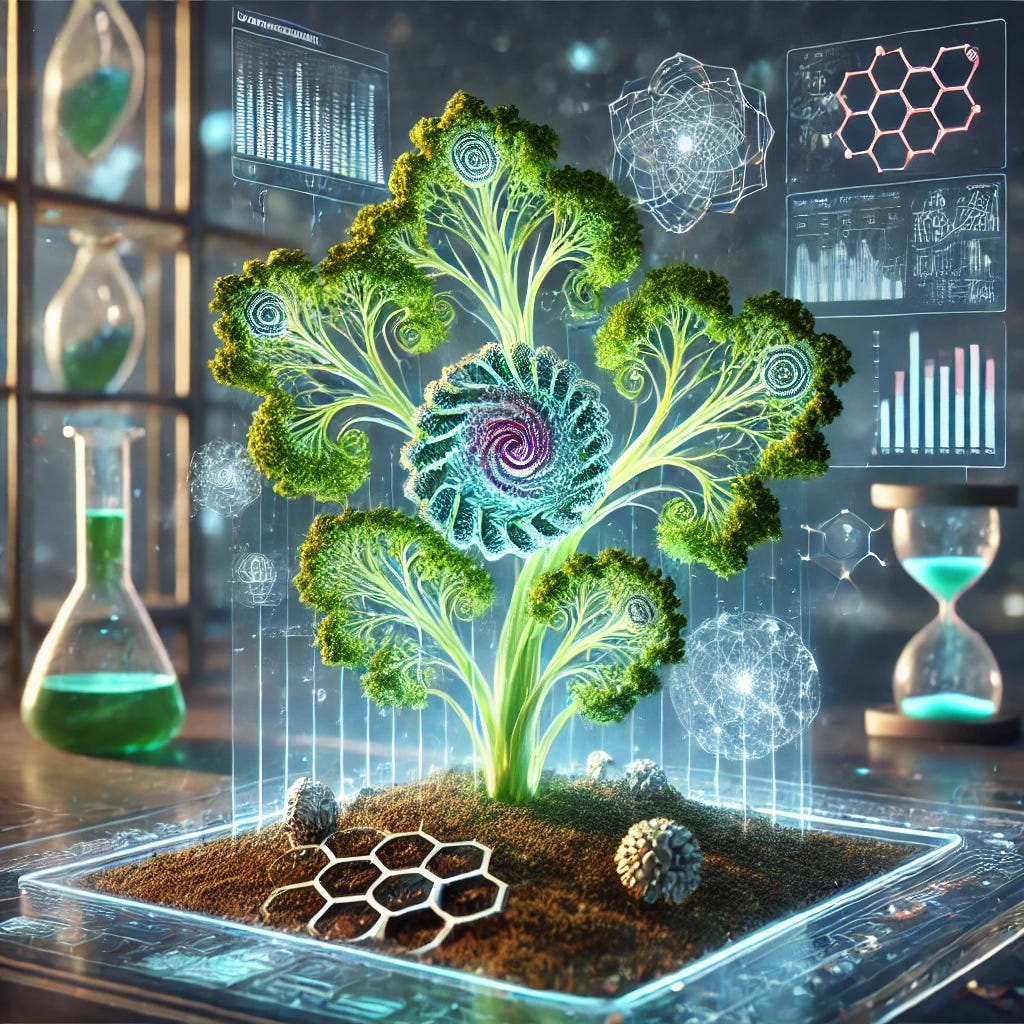
Fractal nutrient encoding posits that plants do more than grow, they remember. By storing ecological history in spatial molecular patterns, they may offer a form of biological memory that is decentralized, fractal, and robust. Such a discovery would not only reshape botany and ecology but also expand our understanding of information processing in non-neural life forms.
References
Farquhar, G. D., Ehleringer, J. R., & Hubick, K. T. (1989). Carbon isotope discrimination and photosynthesis. Annual Review of Plant Physiology and Plant Molecular Biology, 40(1), 503-537.
Kabata-Pendias, A., & Pendias, H. (2001). Trace elements in soils and plants. CRC Press.
Mandelbrot, B. (1983). The Fractal Geometry of Nature. W.H. Freeman and Company.
Niklas, K. J. (1994). Plant allometry: the scaling of form and process. University of Chicago Press.
Davies, P. C. W. (2019). The demon in the machine: How hidden webs of information are solving the mystery of life. University of Chicago Press.
Extremely interesting. Gardening and plant science is a hobby of mine.