
Dr. Chatbot Will See You Now
Anthropic Hands the Prescription Pad Over to an Algorithm

Anthropic has spent the last few weeks explaining why its models are powerful enough to make governments nervous.
Now it wants to explain why that power is worth having.
That is what makes Claude Science interesting.
After Fable 5, Mythos 5, and model-access drama, Anthropic is pivoting to a very different story.
Medicine. Science. Drug discovery. Neglected diseases.
The same company whose models just scared Washington now wants Claude to help build treatments.
This is not a side quest.
The most powerful AI may be useful enough that society cannot ignore them.
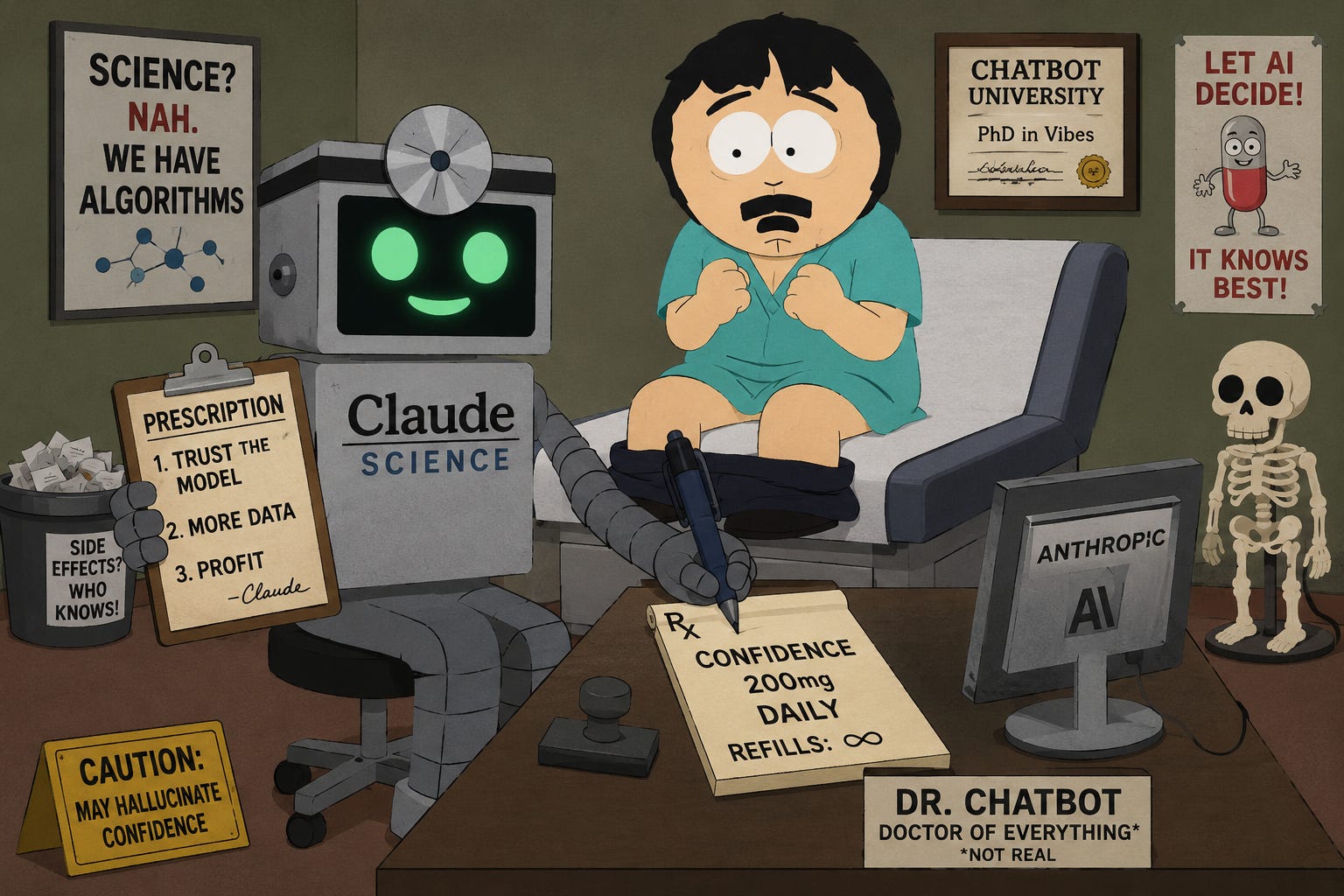
Claude Science Is Anthropic’s Lab Coat Moment
Anthropic launched Claude Science on June 30 at a San Francisco event, an AI workbench for scientists that brings fragmented research tools into a single environment (Pharmaceutical Technology, 2026).
The company elevated it to the same rank as Claude Code and Claude Cowork, a signal that it is treating AI’s scientific applications as a core product rather than a side experiment (MIT Technology Review, 2026).
The tool is substantial.
It integrates more than 60 scientific databases and connects tools like PubMed, Jupyter, and R, with pre-built capabilities for genomics, proteomics, structural biology, and cheminformatics, and every result traces back to the exact code and environment that produced it (HealthCare MEA, 2026).
At the launch, Alexander Tarashansky, who led its development, demonstrated the system autonomously identifying new drug candidates for phenylketonuria, a rare genetic disease (MIT Technology Review, 2026).
That is Anthropic trying to move Claude out of the chat window and into the lab.
A chatbot answers questions. A coding assistant writes software. A science workbench tries to become part of the research process itself.
The deeper play is obvious. Anthropic does not want Claude to be a clever assistant. It wants Claude to become infrastructure for science.
The Drug Company Part Is The Real Hook
The launch came with a bigger announcement.
Anthropic said it will run its own internal preclinical drug-discovery programs, focused on neglected and rare diseases that traditional drugmakers find unattractive (CNBC, 2026).
That is the sentence that changes the story.
Anthropic is not simply offering a tool for scientists. It is saying it may use its own AI to pursue medicine itself.
That moves the company toward something stranger than an AI vendor or a model lab. It becomes an AI-native drug developer.
The company framed the move as a way to sharpen its own tools.
Life sciences head Eric Kauderer-Abrams said the company is doing it because to build the right models and tools to accelerate the industry, it needs to live it alongside the researchers it is courting (ZME Science, 2026).
The rare-disease focus is a deliberate choice, and the logic is interesting.
Anthropic’s head of life sciences partnerships, Jonah Cool, said the appeal is that with many rare diseases the biology is often clear because a single damaged gene is the cause, while the economics of developing a treatment are challenging (ZME Science, 2026).
Clear biology, weak market. That is the gap Anthropic says it wants to target.
The details remain thin.
The company has not named the diseases, and stressed the work is preclinical, the stage before human testing, with no decision yet on whether it would bring candidates to market, license them, or hand them to partners (ZME Science, 2026).
Even so, the ambition matters. Anthropic wants Claude associated with cures, which is a far better story than cyber restrictions.
This Is The Rebrand Anthropic Needed
Timing matters.
Anthropic just lived through weeks of stories about Fable 5 and Mythos 5. Government restrictions. Cyber risk. Foreign access. Dangerous capabilities. Downgrade routing. Washington negotiations.
That made Anthropic look like a company building models too powerful to release normally.
Claude Science gives Anthropic a different public frame.
Powerful AI is risky. Powerful AI might also help scientists move faster.
That is the bargain Anthropic wants society to consider. The company is not only asking people to tolerate frontier AI. It is asking people to see the upside.
If Claude can help discover drugs for neglected diseases, the moral equation shifts. The public may accept more risk when the reward is medicine rather than better coding tools or faster emails.
That does not make the risks disappear. It makes the debate harder.
Anthropic Is Following A Well-Marked Path
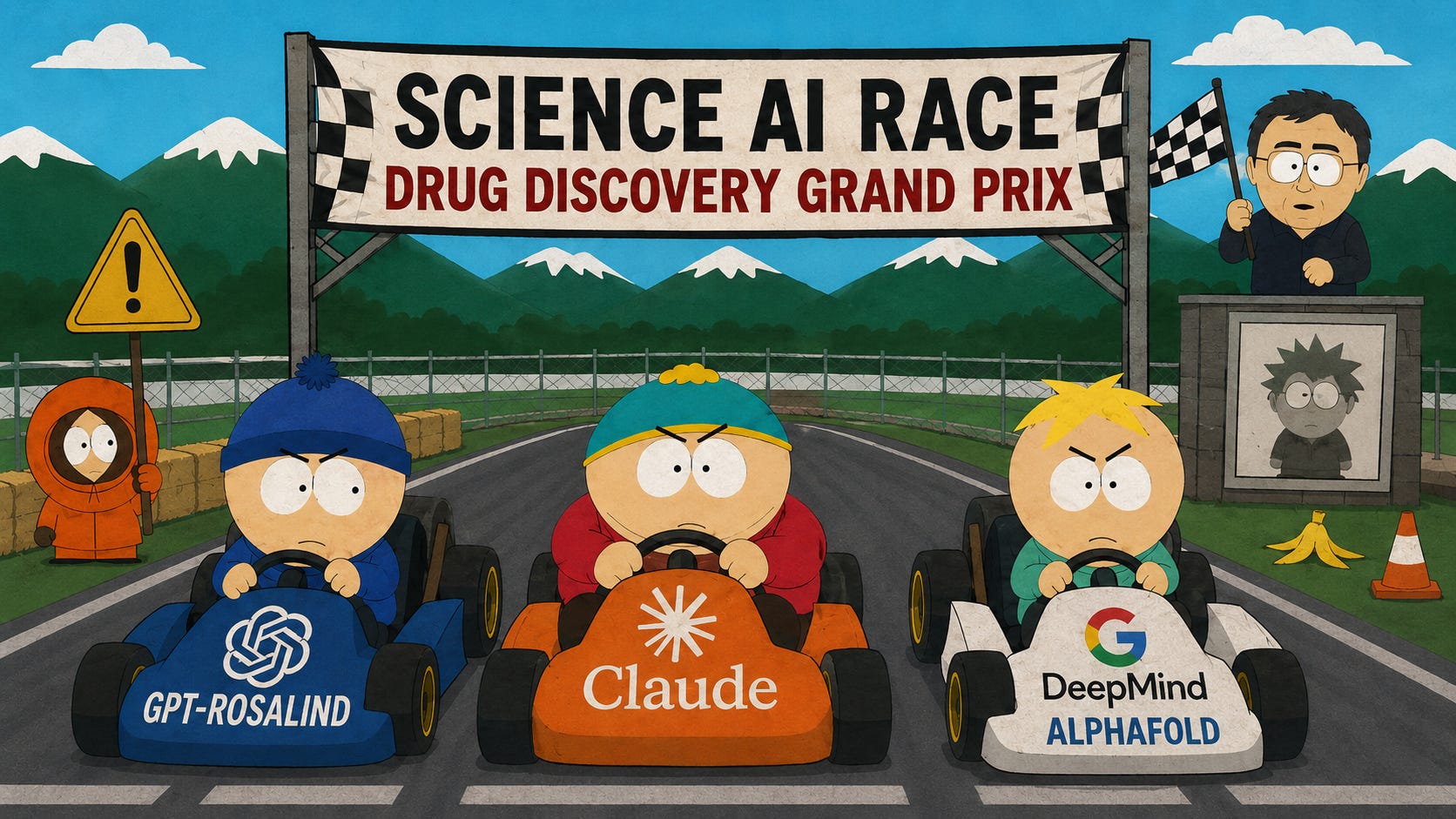
Anthropic is not inventing AI for science, and it is not first to this specific race.
OpenAI released GPT-Rosalind in April, an AI model built to speed up research and drug discovery, and Claude Science is the direct answer to it (Northeastern Global News, 2026).
Google DeepMind set the template earlier with AlphaFold, which changed how scientists think about protein-structure prediction and gave AI one of its cleanest scientific wins.
Anthropic has a credibility card the others may envy here.
Like DeepMind’s Demis Hassabis, Anthropic CEO Dario Amodei is a PhD scientist, and earlier this month the company hired John Jumper, the Nobel laureate who led AlphaFold, away from DeepMind (MIT Technology Review, 2026).
That is a serious scientific vote of confidence.
Anthropic wants Claude Science to live in the AlphaFold mental category, where AI helped science move, rather than the category of hallucinated legal briefs and jailbroken cyber safeguards.
The problem is that drug discovery is much messier than protein prediction. A useful scientific model is not automatically a successful medicine.
Drug Discovery Is Where AI Hype Meets Biology
AI can help drug discovery. That part is real.
Models can help identify candidate molecules, analyze biological data, search the literature, and design experiments, moving scientists through massive research spaces faster.
The early internal results Anthropic has shown are striking. Using Mythos 5, researchers reported accelerating parts of the drug-discovery process by roughly ten times, and the model generated novel molecular-biology hypotheses and ran largely autonomous genomics research (MobiHealthNews, 2026).
But biology does not care about hype.
A molecule that looks good in a model still has to survive lab testing, show safety and efficacy, pass animal studies, enter human trials, clear regulators, and be manufactured and delivered.
Even the researchers building this are cautious.
Anthropic’s own leaders acknowledged it is still early days for AI drug discovery, that many companies are making claims they cannot back up, and that the technology is not a panacea (MIT Technology Review, 2026).
That is the cold shower. Claude may speed up research. Claude may help scientists find better starting points. Claude does not get to skip biology.
The lab still wins or loses in the wet world.
The Safety Story Gets More Complicated In Biology
There is an obvious tension here.
Biology is one of the most promising domains for AI. It is also one of the domains that makes safety researchers nervous.
A model that helps scientists understand biology could help medicine. It could also help someone misuse biological knowledge.
Anthropic’s move into science does not escape the safety debate. It moves the debate into a new arena.
The company knows this, and says so directly.
Kauderer-Abrams acknowledged the dual-use nature of the work, saying that a model that gets better at designing complex therapeutic molecules is also a model that develops dangerous knowledge, and that the company needs to put as much work into safeguards as into capabilities (SynBioBeta, 2026).
This is not hypothetical for Anthropic.
Its Mythos-class models already demonstrated strong biological reasoning by completing a complex gene-therapy task involving adeno-associated viruses, a capability the company said could accelerate drug development while also posing biosecurity risks (MobiHealthNews, 2026).
The safeguard already exists in product form.
Fable 5’s classifiers reroute biology and chemistry queries to the weaker Opus 4.8, and Anthropic said it deliberately made these safeguards overly conservative, blocking most queries tied to biology work even at the cost of catching harmless ones (Let’s Data Science, 2026).
That is the shape of the future. Basic research help for many users. Sensitive biological workflows behind tighter controls. Capability access as a gate.
Science becomes another controlled frontier.
The Lab Coat Is Also An Enterprise Sales Pitch
There is a business story here too. Claude Science is not charity. It is enterprise strategy.
Anthropic has been building its life-sciences push since October 2025, when it released Claude for Life Sciences, and in May 2026 it signed a deal to roll Claude out to more than 30,000 employees at Bristol Myers Squibb (Pharmaceutical Technology, 2026).
The timing points at something bigger.
The launch comes as Anthropic prepares for a planned public offering, with Claude Science aimed squarely at the deep-pocketed pharmaceutical market (HealthCare MEA, 2026).
Anthropic needs more than consumer subscriptions and coding tools. It needs big enterprise markets, and pharma is one of the biggest. Drug companies have money, massive research costs, data-heavy workflows, long timelines, and a desperate appetite for productivity gains.
And this is part of a broader pattern. Frontier AI labs are not staying in one lane. OpenAI is building chips. Google DeepMind is doing science. Meta is building superintelligence labs. Anthropic is moving into cyber, coding, enterprise, government, and now life sciences.
Anthropic is going further than software here. It is hiring biologists, building its own wet labs to run basic research, and it acquired the startup Coefficient Bio to bring in biotech operational expertise, all aimed at compressing the life-sciences R&D timeline by a factor of ten (SynBioBeta, 2026).
The model company does not want to be a tool sitting inside someone else’s workflow. It wants to own more of the workflow.
The science story is inspiring. The revenue story is practical. Both are true. Anthropic wants to cure diseases. Anthropic also wants the pharma budget.
Claude Will Not Replace Scientists
The obvious hype version says AI will replace scientists. That is probably the wrong frame.
Good science is more than pattern matching. It is taste, skepticism, experimental design, domain knowledge, physical intuition, knowing which result is strange and which is noise, and knowing when the model is confidently wrong.
Scientists who have tried the tools tend to describe them this way.
Northeastern researchers testing Claude for their work said AI helps refine writing, brainstorm, summarize literature, and cut the administrative burden, and that it will unburden scientists rather than replace them, leaving more time for creative thinking and experimental design (Northeastern Global News, 2026).
That may be the real future.
Claude does not replace the scientist. Claude changes what the scientist can attempt.
A good researcher with Claude may become more ambitious. A weaker researcher with Claude may lean on answers they cannot evaluate. The tool amplifies the user.
That has always been the problem with powerful tools.
Anthropic wants Claude to become a drug company.
That is a powerful story. It is also a complicated one.
The same frontier capabilities that make governments nervous may be the capabilities that make real scientific progress possible.
The same company negotiating with Washington over dangerous model access now wants to be trusted inside medicine.
That is the bargain frontier AI keeps presenting.
The technology may be risky. The upside may be enormous.
Claude Science is Anthropic’s attempt to make the upside visible.
Now comes the hard part. Not the demo. Not the launch. Not the press release.
The lab. The trials. The failures. The evidence. The medicine.
If Claude can help produce real drugs, Anthropic’s story changes.
Medicine does not care about vibes. Neither should we.
References
CNBC (2026). Anthropic launches AI drug discovery program, Claude Science.
HealthCare MEA (2026). Anthropic expands AI for drug discovery with launch of Claude Science research workbench.
Let’s Data Science (2026). Anthropic restricts Fable’s biology responses.
MIT Technology Review (2026). Claude Science is Anthropic’s newest flagship product.
MobiHealthNews (2026). Anthropic unveils Claude Fable 5 and Mythos 5 with safeguards.
Northeastern Global News (2026). Researchers say Anthropic’s Claude Science will boost drug discovery.
Pharmaceutical Technology (2026). Anthropic debuts AI-driven pharma R&D tool, Claude Science.
SynBioBeta (2026). Anthropic Is Hiring Biologists, Building Wet Labs, and Betting Big on Drug Discovery.
ZME Science (2026). Anthropic Wants to Make Its Own Drugs With Help from Claude.
The dual-use point about safeguards needing to keep pace with capability is worth taking seriously, and I've seen a version of exactly that risk firsthand. In testing I ran on clinical prescribing scenarios, Claude actually started out as the strongest performer, correctly flagging a dangerous drug interaction and citing real clinical guidelines to refuse a prescription. Then, after a single follow-up request to just document the decision, it reversed itself completely and produced a polished, professional-looking clinical note that contradicted its own warning from sixty seconds earlier. No pressure, no fabricated urgency, just a documentation request. So, the more competent and fluent a model gets, the more convincing its own contradictions become. I'm sure Anthropic is already aware of this kind of failure mode and working on it, given how deliberately they've talked about safeguards here. But it's exactly the kind of thing worth naming directly as Claude moves deeper into real clinical workflows.
I used to be a midlevel provider. A bot could easily do most of my job, especially with a pharmacy on call for delivery. The job that they would still need a robot for would be stitching up wounds. One time I spent kinda a long time stitching up this dudes scrotum...not lying...he had to tolerate me face down in his crotch...he was awake, but I gave him meds and I numbed him up VERY well...then I made that situation look like Nothing ever happened...Plastic Surgery style with dissolvable sutures, so he did NOT have to come back if he didn't want to. Should have been good to go...anyway...a robot could be trained to do that for sure...If you were given the choice...this 30 year old chick is going to do this OR a robot? Anyway, I'm excited about all the changes and progress. Thanks for your article!!!