
Delegated Responsibility
How AI Is Quietly Rewriting Accountability

When people talk about the risks of AI, they usually focus on dramatic futures. Job loss. Superintelligence. Conscious machines. Those make for clean debates, but they miss the more immediate change already unfolding.
AI is not just automating tasks or making recommendations. It is becoming the place where responsibility quietly goes to disappear.
More and more decisions that used to belong to humans are now made “with the help of AI.” And when something goes wrong, no one can clearly say who is accountable anymore.
This is not a future problem. It is already happening in workplaces, hospitals, courts, financial systems, and everyday consumer products.
AI is not replacing judgment. It is dissolving ownership of judgment.

How Responsibility Used to Work
Traditional systems assumed a clear chain of responsibility. A person made a decision. If that decision caused harm, someone could be questioned, blamed, or held accountable. This structure underpins law, ethics, and organizational trust.
Even when tools were involved, responsibility stayed human. A calculator could be wrong, but the accountant was still responsible. Software could fail, but the operator still signed off.
That clarity mattered. It created incentives to be careful, to explain decisions, and to internalize consequences.
AI changes this structure in a subtle but profound way.
The Rise of “AI Assisted” Decisions
AI systems are now embedded in decisions about loan approvals, insurance pricing, medical triage, hiring, content moderation, fraud detection, and criminal risk assessment. In most of these cases, humans are still “in the loop,” at least on paper.
But in practice, people defer. When a system produces a score, ranking, or recommendation, it carries the weight of objectivity. Studies show that humans tend to over trust algorithmic outputs, even when they know the system can be wrong (Dietvorst et al. 2015).
The decision shifts from “I chose this” to “the system indicated this.”
Responsibility becomes distributed, and distribution often means disappearance.
Nobody Is in Charge Anymore
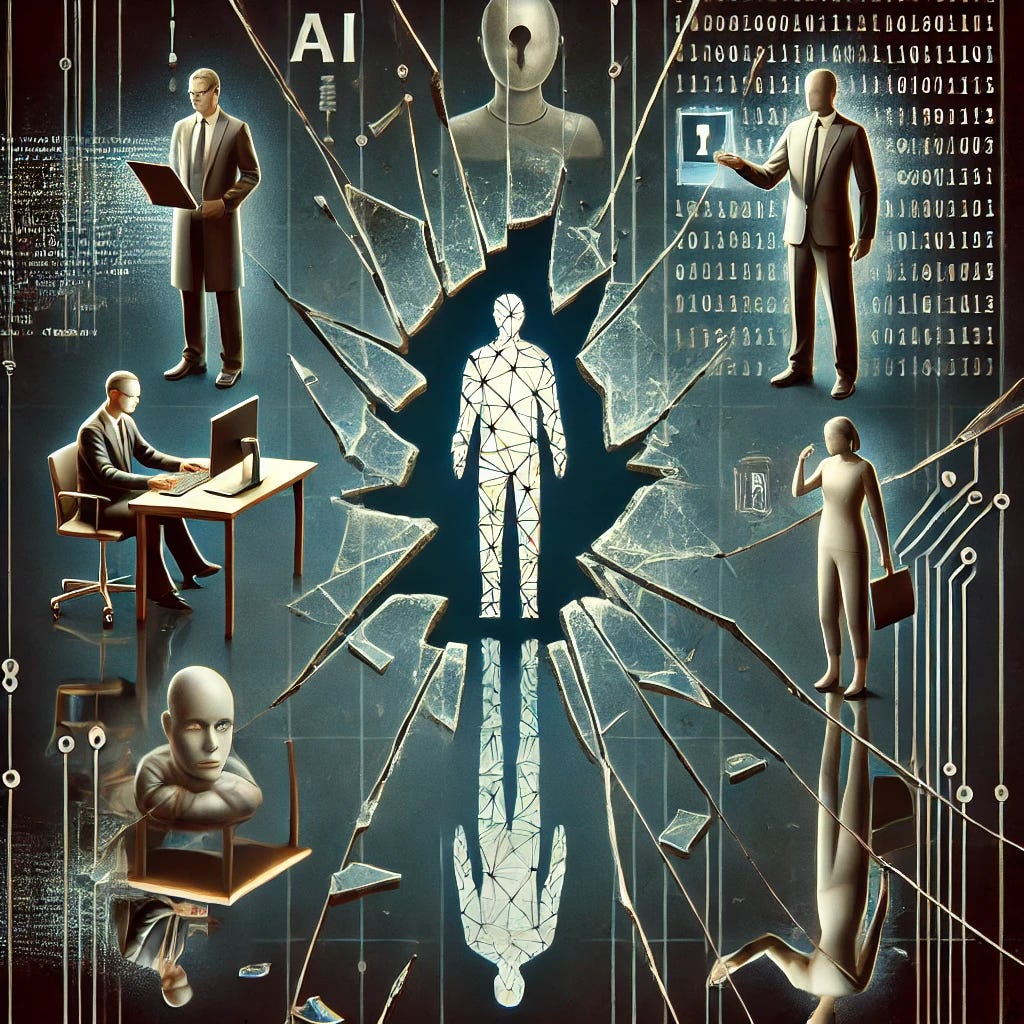
When an AI mediated decision causes harm, responsibility fragments. Was it the developer who built the model. The organization that deployed it. The data used to train it. The regulator who approved it. The human who clicked confirm.
Legal scholars have warned that algorithmic systems create accountability gaps where harm occurs without a clear locus of blame (Pasquale 2015). These gaps are not accidental. They are a natural consequence of complex systems optimized for performance rather than explainability.
Everyone touches the decision. No one owns it.
This is convenient for institutions. It reduces liability. It diffuses blame. It allows organizations to claim neutrality while exercising enormous power.
Medicine, Finance, and the Shrinking Doctor
In healthcare, clinical decision support systems increasingly guide diagnosis, treatment prioritization, and resource allocation. These tools can improve outcomes, but they also shift responsibility.
When an AI system flags a patient as low risk and that patient deteriorates, doctors are caught in an impossible position. Ignoring the system exposes them to institutional risk. Following it exposes patients to harm. Studies show that clinicians often defer to AI even when their own judgment disagrees, especially under time pressure (Greenhalgh et al. 2019).
The doctor is still present, but their authority has been quietly hollowed out.
The same pattern appears in finance, where risk models dictate credit access, pricing, and surveillance. Human judgment remains nominal, but system outputs dominate outcomes (O’Neil 2016).
Automation Without Agency
This creates a new kind of system. One where decisions happen, effects occur, but agency is unclear. Philosophers call this moral outsourcing. Responsibility is shifted onto systems that cannot be morally accountable, while humans retain just enough distance to deny ownership (Danaher 2016).
AI does not need intentions to create this effect. It only needs authority.
Once a system is seen as more accurate, more neutral, or more efficient than a person, responsibility naturally flows toward it, even though it cannot carry that burden.
Why This Is Dangerous
Societies rely on responsibility to function. Accountability is what allows trust, correction, and learning. When something fails, someone must be able to say “this was my decision” for systems to improve.
When responsibility dissolves, failures repeat. Bias persists. Harm becomes normalized. And power concentrates in places that cannot be questioned directly.
This is not about rogue AI. It is about well functioning systems operating exactly as designed.
The danger is not that AI makes bad decisions.
The danger is that no one feels responsible when it does.
The Path Forward Is Not Technical
More transparency helps, but it is not enough. Explainable AI does not automatically restore responsibility. Clearer models do not force humans to own outcomes.
What is required is a social decision. Where does responsibility stop. Who must sign their name. Who bears consequences when systems fail.
Some researchers argue that organizations must be legally prohibited from delegating certain decisions entirely, especially in domains involving rights, health, or liberty (Floridi et al. 2018). Others propose strict liability frameworks for AI deployment regardless of human oversight claims.
These are not engineering questions. They are governance choices.
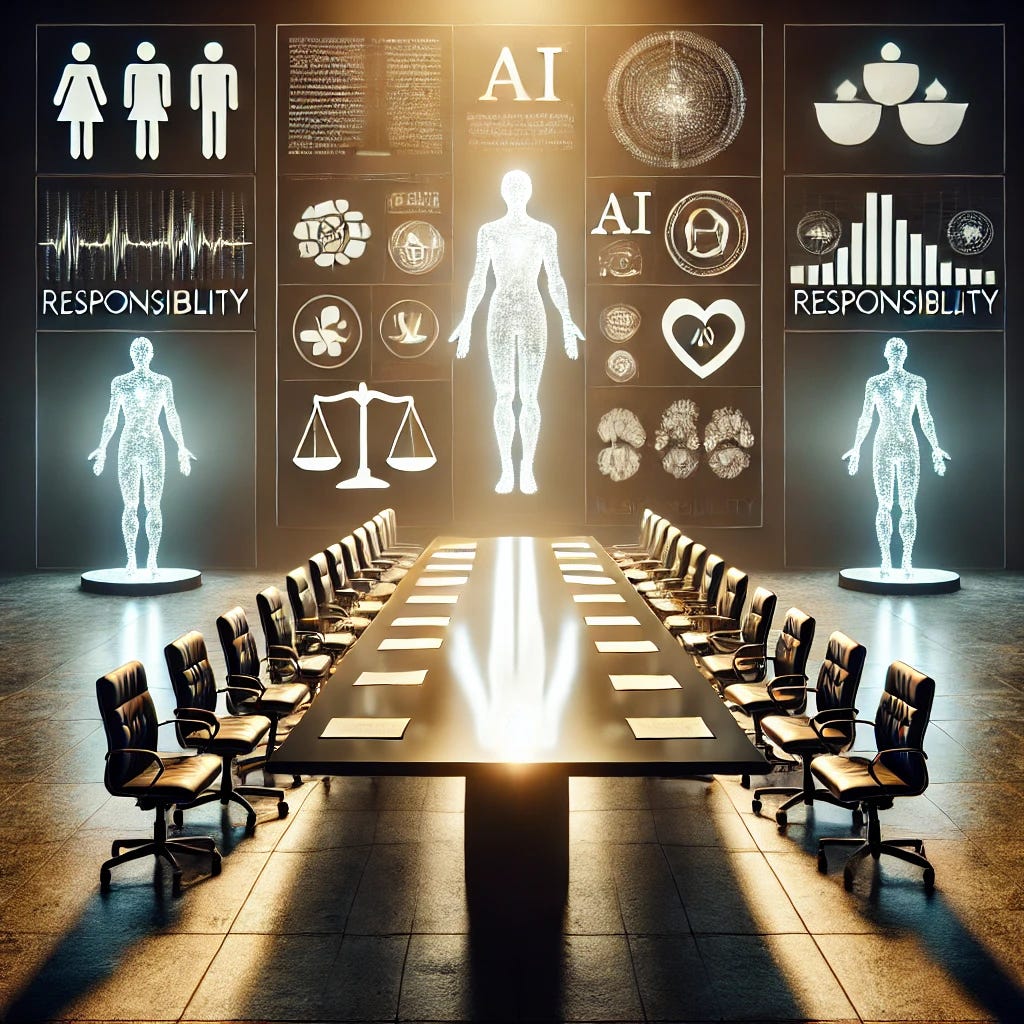
AI is not taking control of the world. Humans are handing something over voluntarily. Not power, but responsibility.
This shift is quiet. It feels efficient. It feels modern. It feels safe. Until something goes wrong and no one can answer a simple question.
Who decided this.
As AI systems become more capable, the most important design choice will not be accuracy or speed. It will be whether we allow responsibility to evaporate or insist that it remain human, even when decisions are machine mediated.
The future will not be decided by what AI can do.
It will be decided by what we refuse to stop being accountable for.
References
Danaher, J. (2016). Robots, law and the retribution gap. Ethics and Information Technology, 18(4), 299–309.
Dietvorst, B. J., Simmons, J. P., & Massey, C. (2015). Algorithm aversion. Journal of Experimental Psychology: General, 144(1), 114–126.
Floridi, L., Cowls, J., Beltrametti, M., et al. (2018). AI4People—An ethical framework for a good AI society. Minds and Machines, 28, 689–707.
Greenhalgh, T., Wherton, J., Papoutsi, C., et al. (2019). Beyond adoption: A new framework for theorizing and evaluating nonadoption, abandonment, and challenges to the scale-up of health technologies. Journal of Medical Internet Research, 21(11).
O’Neil, C. (2016). Weapons of Math Destruction. Crown Publishing.
Pasquale, F. (2015). The Black Box Society. Harvard University Press.
1; To delegate responsibility is to abdicate
2. "The devil made me do it"--Flip Wilson's "Geraldine"
While I don’t disagree completely, the majority of the basis for your argument is leveraging and quoting sources from 2015 - 2019 when most algorithmic focuses were on machine learning - which, while an underpinning technology of artificial intelligence, is not the same modern AI that we have 1/2 decade + that you outline in your argument.
Were we agree is that commitment to responsibility is a very good topic that needs to be discussed as society progresses forward with learning the ethical, equitable, and effective use of AI…
What happens when my Tesla gets pulled over for speeding because I chose to enable a profile that allowed it to go well over the speed limit? Who gets the ticket?
When a student simply creates a well structure effective prompt that allows AI to craft a well structured and cited paper… who receives the A? Can we call that plagiarism? No author was plagiarized? OpenAI, and other AI companies terms of service attributes all rights to both the prompt AND the generated output to the end user… does that effectively provide authorship under copyright?
When artificial intelligence supports a doctor’s decision or provides a perspective and depth of knowledge to allow a doctor to treat and save a patient’s life, who get credit for that outcome? How does the treatment fee get effectively split? Does that or should that bolster the doctor’s reputation or expertise? Does the treated healed patient care or are they grateful because the other 5 doctor’s they saw who didn’t leverage AI continued their suffering for an extra 2 years while undergoing ineffective treatments…
I agree, these discussions are real and important, and will determine how impactful AI will be interwoven into society. They also need to be approached looking toward to positive impact and influence well constructed AI can bring, not simply from the perspective of abdicating responsibility.
The centuries have produced reams of data and materials and stories of individuals abdicating responsibility as well as the harmful impact of human bias, human deceit, human negligence, human malpractice, and malfeasance harming individual individuals…
This discussion is not “new” and is not exclusive to AI. We have not resolved this nor do we have a solution for it when directly applies to human beings and the society we have evolved over the centuries. Poor decision making and delegating or deferring or sidestepping responsibility is a societal issue. Maybe AI will force this discussion and become a positive influence for change…