
CRISPR Gene Editing Explained
Exploring ChatGPT

CRISPR (Clustered Regularly Interspaced Short Palindromic Repeats) is a system that bacteria use to defend against viruses. It works by storing short sequences of DNA from viruses that the bacteria have previously encountered. If the same virus infects the bacteria again, CRISPR uses these stored sequences to identify and cut the virus's DNA, which stops the virus from replicating.
Scientists have adapted this system for use in gene editing, a process that involves making precise changes to an organism's DNA to modify or repair a gene. The CRISPR system can be programmed to target a specific region of DNA and make a change, such as deleting or replacing a faulty gene. This makes it a powerful tool for treating genetic diseases, as well as for research on the function of specific genes.
CRISPR has the potential to revolutionize the way we treat genetic diseases and understand the function of genes, but it is also a controversial technology, as it has the potential to be used for unethical purposes, such as creating genetically modified organisms for use as bioweapons or for human enhancement.
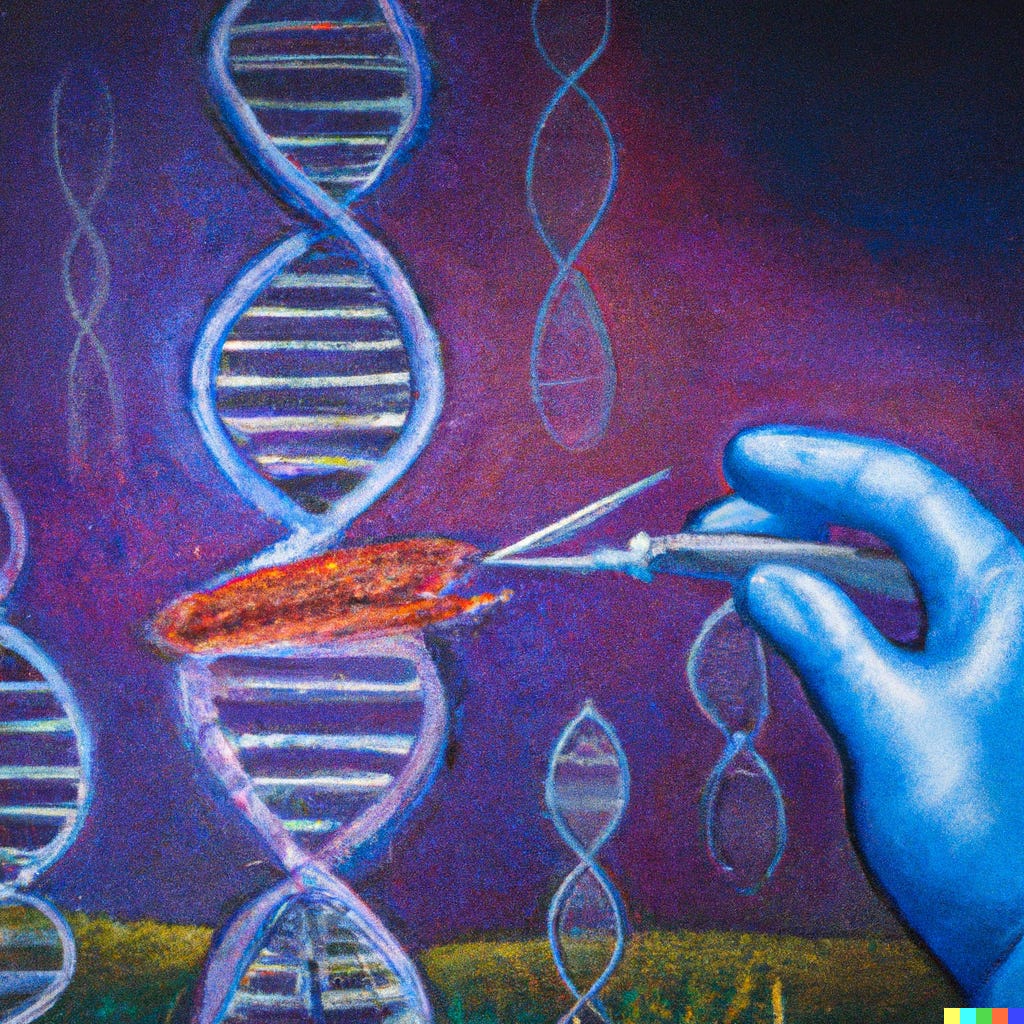
The CRISPR system consists of two main components: CRISPR-associated (Cas) enzymes, which cut DNA, and small RNA molecules that guide the Cas enzymes to the correct location in the DNA. There are several types of Cas enzymes, each of which has a specific function. For example, Cas9 is the most commonly used enzyme in CRISPR gene editing because it can make precise cuts in DNA and is easy to program with a guide RNA.
To use CRISPR for gene editing, scientists first design a small RNA molecule, called a guide RNA, that targets a specific location in the DNA. The guide RNA is then combined with a Cas enzyme and introduced into a cell, where it seeks out and binds to the targeted DNA sequence. Once the guide RNA has found its target, the Cas enzyme cuts the DNA at that location.
At this point, the cell's repair mechanisms can be used to make changes to the DNA. For example, if the cell is provided with a piece of DNA that contains the correct version of a faulty gene, it can use this template to repair the damaged DNA by copying the correct sequence over the faulty one. Alternatively, the cell can simply be left to repair the cut on its own, which can result in the deletion of a small piece of DNA.
CRISPR is a very precise and efficient tool for gene editing, but it is not without its limitations. One challenge is that the guide RNA must be designed to target a specific location in the DNA, which can be difficult if the target sequence is not well understood. In addition, there is the potential for CRISPR to make unintended changes to the DNA, and more research is needed to understand and minimize these off-target effects.