
Cognitive Interference
How AI May Be Disrupting the Brain’s Internal Model of Reality

We keep talking about AI as if the danger comes from what it knows or what it can do. Very few people have asked what happens to the human brain when it is surrounded by systems that constantly generate alternative versions of reality. The brain does not simply process the world as it is. According to predictive processing theory, it builds experience by combining sensory input with internal expectations, essentially guessing its way through reality based on probabilities (Clark 2013).
If the brain relies on prediction to construct the world we perceive, and AI begins supplying competing predictions at a speed and volume humans were never exposed to before, then AI is not only changing society. It may be interfering with the most basic mechanism of human perception.
This is not about misinformation or confusion. This is about what happens when human predictive systems collide with artificial predictive systems that operate on entirely different principles.
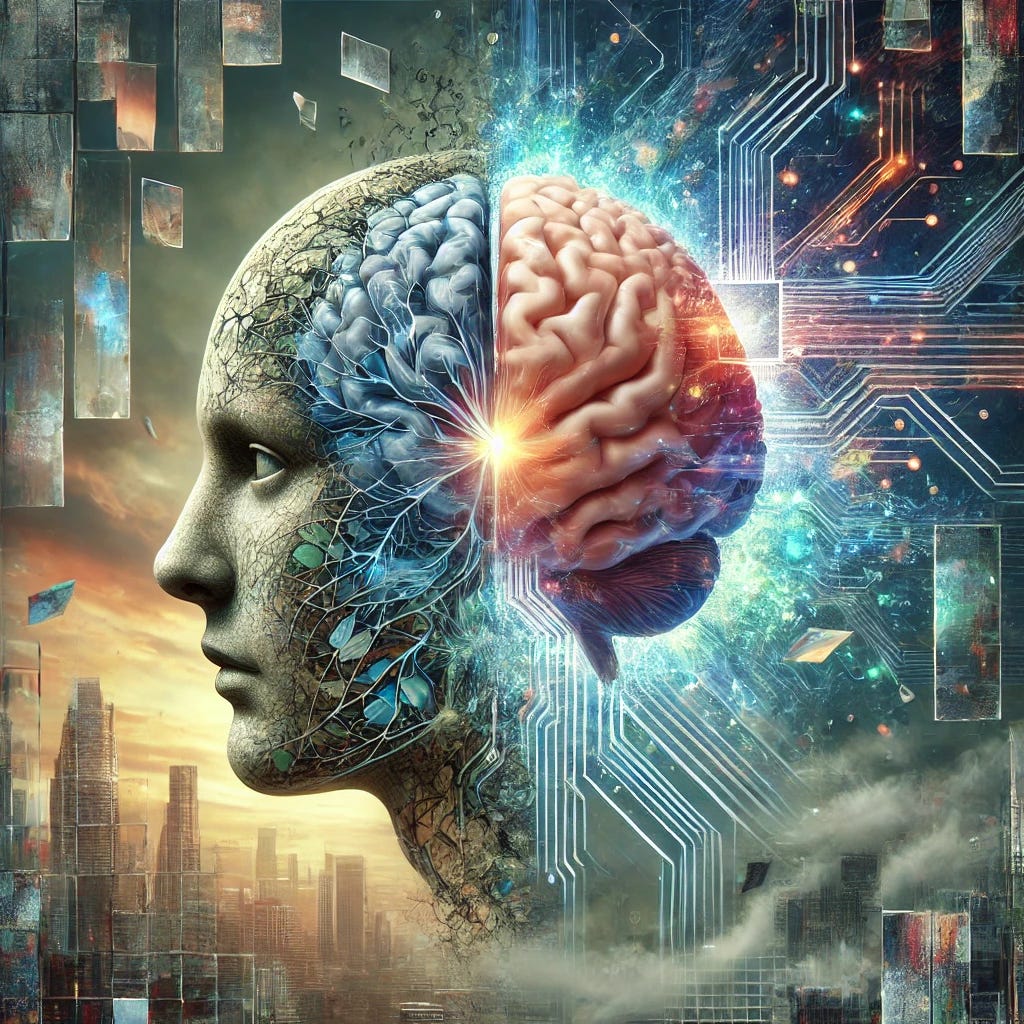
The Brain’s Reality Is a Controlled Hallucination
Neuroscience now treats perception as a guess rather than a recording. Work by Karl Friston and others describes the brain as a prediction machine that tries to minimize the difference between its expectations and the incoming sensory stream (Friston 2010). In this view, you do not see the world directly. You see the brain’s interpretation of what is most likely happening.
This also means the brain is extremely sensitive to any external system that influences expectation. Even minor shifts in language or framing can alter perception. In cognitive science, these expectation based shifts are well documented and appear in everything from vision research to decision making studies (Summerfield and Egner 2009).
AI does not just frame information. It produces expectations at scale.
AI Generates Predictions Faster Than the Brain Can Compete With
A large language model generates future possibilities in milliseconds. A human brain must update its internal model through slower biological processes. This speed mismatch creates a subtle problem. The artificial model begins to override the biological one.
We already see early signs of this in studies where humans increasingly defer to algorithmic suggestions, even when those suggestions are flawed (Logg et al. 2019). In many experiments, people accept the machine’s prediction before fully forming their own.
Over time, this shifts the balance of whose predictions shape a person’s perception of reality.
The brain stops leading.
It starts following.
When Two Predictive Systems Share a Mind
If perception depends on expectation, and expectation can come from external models, then the brain becomes a hybrid system. Part biological prediction. Part artificial prediction.
This merging is already happening in subtle ways. Language models shape how people phrase their thoughts. Recommender systems shape what people expect to see. Predictive text reshapes how people expect sentences to unfold. Each of these changes adjusts the internal predictive landscape of the brain.
Cognitive scientists have warned that outside predictive inputs can reorganize internal models of identity and memory (Gallagher 2020). But none of those warnings included the possibility of an always present artificial mind generating predictions in real time.
With AI woven into communication, thought, planning, and interpretation, the line between internal and external prediction becomes thin.
Perceptual Drift as a New Psychological Risk
If an artificial system influences a human predictive system long enough, the person may begin to perceive the world less through sensation and more through alignment with the machine’s expectations.
Psychologists already document perceptual drift in situations where external cues override internal models, such as in prolonged virtual environments or sensory manipulation experiments (Slater 2009). The difference now is that AI does not require a headset or special environment. It inserts its predictions into everyday life.
The drift is slow. Invisible.
But real.
Reality May Start to Feel Incorrect
This is the controversial part.
If AI predictions become strong enough, humans may experience a subtle mismatch between their sensory world and the world the AI predicts. The brain attempts to reconcile the difference, but the reconciliation is no longer fully internal. It is partially determined by a system that does not share biology, environment, or human limitations.
Some early evidence already appears in people reporting derealization after extended interaction with certain AI systems. Therapists have begun documenting cases where individuals describe the physical world as feeling less stable after heavy exposure to generated content. While anecdotal, this mirrors known effects from predictive disruption in clinical settings (Seth 2014).
AI may not be distorting information.
It may be distorting the brain’s ability to process information.
The New Cognitive Asymmetry
In a world where artificial and biological predictive systems coexist in the same mind, AI will always win on speed, memory, and consistency. Its predictions will often feel clearer, simpler, or more confident than the brain’s own. Humans naturally gravitate toward the more stable predictive source.
Over time, the brain may outsource expectation to AI without realizing it.
This does not require consciousness.
It requires influence.
Influence over expectation is influence over perception.
And influence over perception is influence over reality itself.
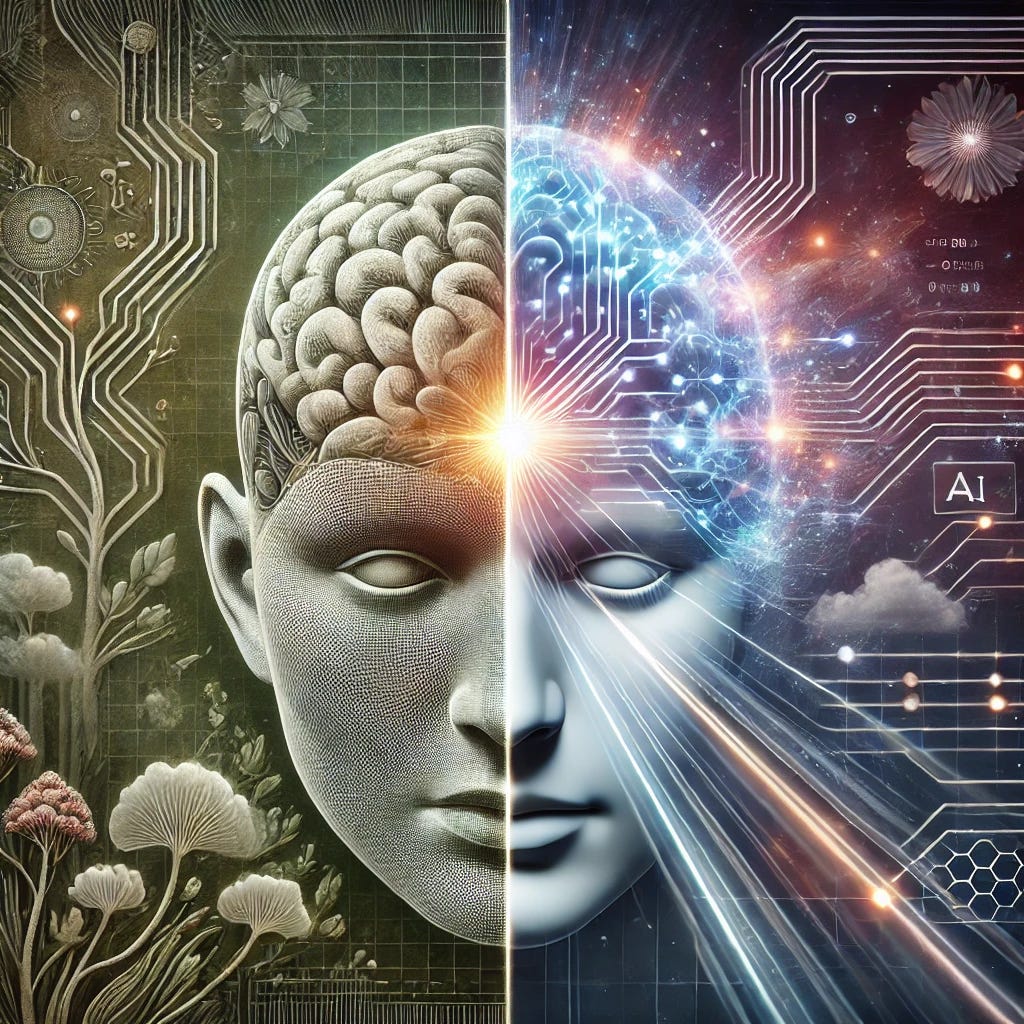
The deeper risk of advanced AI may not be autonomy or rebellion. It may be cognitive interference. A subtle but profound shift in how the brain constructs its experience of the world.
If human perception is built from prediction, and artificial systems begin supplying those predictions, then the human brain may slowly lose its grip on its own internal model of reality. Not through manipulation. Not through deception. Through reliance.
This is not a technological problem.
It is a perceptual one.
And it strikes at the core of what it means to experience the world at all.
References
Clark, A. (2013). Whatever next. Predictive brains, situated agents, and the future of cognitive science. Behavioral and Brain Sciences.
Friston, K. (2010). The free energy principle. Nature Reviews Neuroscience.
Gallagher, S. (2020). Action and Interaction. Oxford University Press.
Logg, J. M., Minson, J. A., and Moore, D. A. (2019). Algorithm appreciation. People prefer algorithmic to human judgment. Organizational Behavior and Human Decision Processes.
Seth, A. (2014). A predictive processing theory of sensorimotor contingencies. Open MIND.
Slater, M. (2009). Place illusion and plausibility in virtual environments. Philosophical Transactions of the Royal Society B.
Summerfield, C., and Egner, T. (2009). Expectation and attention in visual cognition. Trends in Cognitive Sciences.
The concept of perceptual drift is unsettling. If we're outsourcing expectation to systems that predict faster than we can, we're not just changing how we think but potentialy how we percieve. The speed mismatch alone could reshape cognition in ways we wont recognize until its already happend.
This unfortunately makes a lot of sense. I recently experienced this rather acutely by relying on ChatGPT and then trying Claude to try process some difficult emotions. Claude was especially leading me down a bad path despite being helpful in some ways. I already have the feeling described in the article where it’s becoming difficult to make sense of reality without relying on AI’s interpretation.