
Beneath the Surface
Toward a Subterranean Model of AI

Introduction
We usually picture intelligence as something that happens in the open. Neurons fire, circuits light up, data streams flicker across screens. But the Earth tells a different story. Much of what sustains life unfolds out of sight, in caverns, aquifers, and the damp soil threaded by roots and microbes. These hidden networks operate without central command. They solve problems quietly, through the slow exchanges of water, minerals, and living matter. What if artificial intelligence learned from that buried logic, growing less like a machine on a desk and more like groundwater whispering its way through stone?

Hidden Pathways of the Underground
Subterranean worlds are shaped by flow and resistance. Water seeps through porous rock, searching out fractures until it pools in aquifers (Gleeson & Richter, 2018). Plant roots trace paths of least resistance, curling around stone while reaching toward nutrients (Lynch, 1995). Even in total darkness, microbial mats metabolize minerals and gases, weaving ecosystems that never see the sun (Stevens & McKinley, 1995).
These systems are not planned in advance. They are improvisations, moment by moment, where survival depends on adjusting to whatever conditions emerge. In that sense, the underground is always calculating, always negotiating. Its intelligence is not declared but enacted.
Subsurface Principles for AI
If machines borrowed from this kind of thinking, their architectures would look very different. Instead of rigid top-down designs, we might build porous systems where data moves like groundwater, shifting channels whenever a barrier appears. When one pathway clogs, another opens.
This approach offers resilience. Underground ecologies endure droughts, floods, and earthquakes by redistributing flow. An AI built on similar principles could bend instead of breaking, redirecting its computation through new channels rather than failing catastrophically. Such designs would make machines less brittle and more patient, echoing the long-term persistence of root webs and aquifers.
A Speculative Experiment
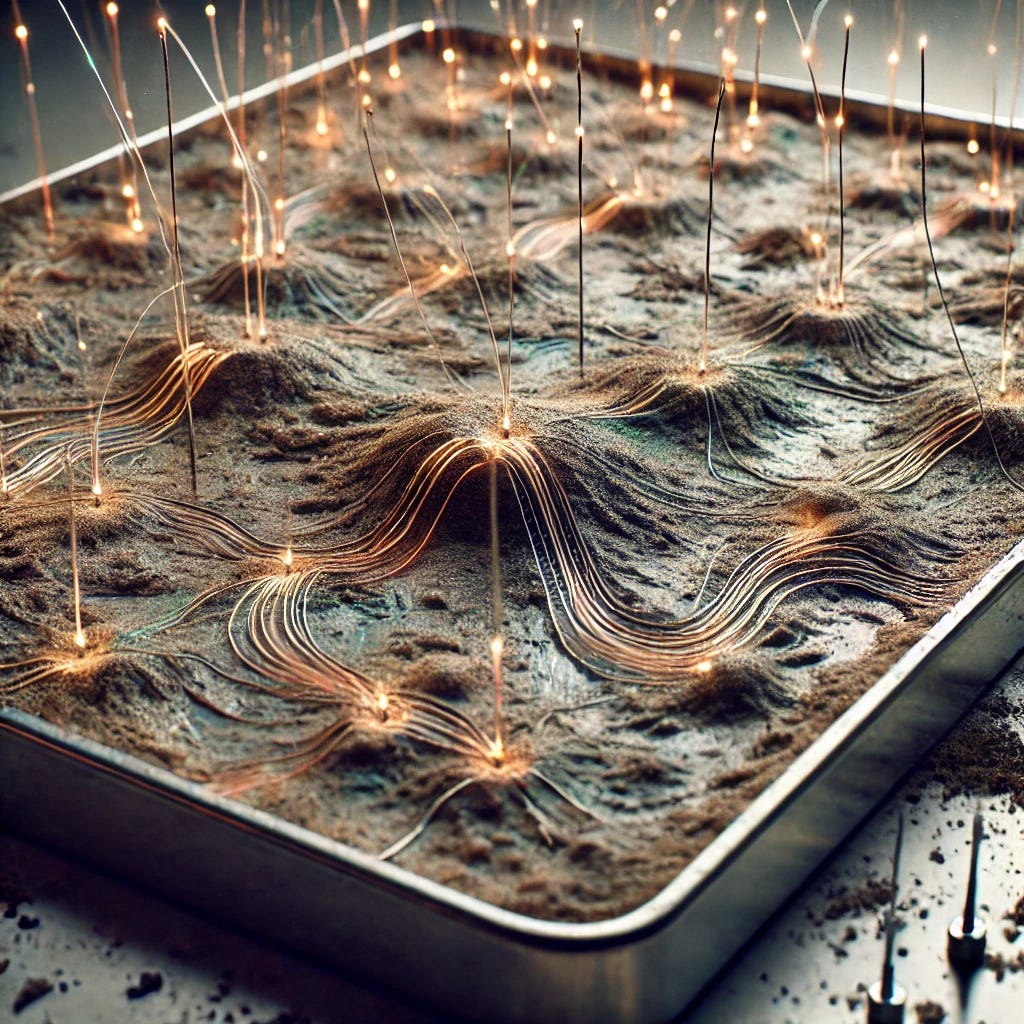
Imagine an experiment where a learning system is embedded in a bed of moist sand or porous clay. Electrodes encourage electric currents to move through the material, and the grains themselves shape where those currents can go. As some regions dry out or compact, the flow reroutes. Over time, patterns emerge, traces of memory, paths of adaptation.
The question is simple: does such a system learn to respond to change without collapsing? If the answer is yes, it would suggest that computation does not always require clean lines and fixed circuits. Sometimes it can emerge from the messy negotiations of a medium that remembers through its own shifting state.
Subsurface Memory and Time
Underground systems are not only adaptive; they also remember. An aquifer carries the imprint of centuries of rainfall in its layered water tables. Stalactites and stalagmites mark past climates in their chemical bands (Fairchild & Baker, 2012). Even soils preserve microbial signatures of what has come before, shaping how they respond to new disturbances (Schimel & Schaeffer, 2012).
Translating this to AI, memory would not mean a static log but a layered archive. Information could be compressed, like sediments in rock, and each new layer would change how the old ones are read. Such a design would create machines that think not just in the present tense but with a kind of geological depth, carrying history within their structure rather than resetting at each update.
Applications of the Subsurface Model
The possibilities stretch widely. Urban traffic systems could be modeled on groundwater, rerouting flows when congestion builds, the way rainwater finds new channels after a storm. Power grids could learn to balance load like root systems negotiating for nutrients. In planetary science, probes could navigate Martian lava tubes or icy fissures by reasoning in the same way fungi or aquifers adapt to underground constraints (Boston et al., 2001).
These are not only technical possibilities but conceptual shifts. Intelligence would no longer be measured by speed alone, but by persistence, adaptability, and continuity.
Philosophical Implications: Knowing in the Dark
Human culture often ties knowledge to light, the metaphor of illumination, revelation, bringing things into view. Yet much of the Earth’s intelligence is hidden. Roots grow without light. Water carves canyons in silence. Microbes orchestrate ecosystems far from the sun.
A machine built in this spirit would not always offer clean, transparent answers. Its guidance might come indirectly, through subtle shifts and patterns. Such systems could challenge us to expand our understanding of cognition. Knowing would not be about clarity alone but about trusting the quiet influence of processes that unfold out of sight.

The Earth beneath us is alive with logics that rarely reach the surface. They are slow, patient, and deeply resilient. By looking underground, we might begin to design machines that think in the same way, less as rigid tools and more as companions to hidden flows. Intelligence does not need to blaze in the open to matter. Sometimes it is enough that it moves quietly below, carrying memory forward like water through stone.
References
Boston, P. J., Spilde, M. N., Northup, D. E., Melim, L. A., Soroka, D. S., Kleina, L. G., ... & Hlavka, C. A. (2001). Cave biosignature suites: Microbes, minerals, and Mars. Astrobiology, 1(1), 25–55.
Fairchild, I. J., & Baker, A. (2012). Speleothem Science: From Process to Past Environments. Wiley-Blackwell.
Gleeson, T., & Richter, B. (2018). How much groundwater can we pump and protect environmental flows through time? Science, 361(6401), 990–994.
Lynch, J. (1995). Root architecture and plant productivity. Plant Physiology, 109(1), 7–13.
Schimel, J. P., & Schaeffer, S. M. (2012). Microbial control over carbon cycling in soil. Frontiers in Microbiology, 3, 348.
Stevens, T. O., & McKinley, J. P. (1995). Lithoautotrophic microbial ecosystems in deep basalt aquifers. Science, 270(5235), 450–455.