
Anthropic Released Fable 5
The Safety Throttle Is The Story

The Release Is The Story
Anthropic just released Claude Fable 5.
On paper, it sounds like exactly what people expected from the next frontier model.
Stronger reasoning.
Better coding.
Better knowledge work.
Better vision.
Better scientific ability.
Anthropic calls Fable 5 a Mythos-class model made safe for general use.
Those words reveal the whole tension.
The model is powerful enough to matter.
And powerful enough that Anthropic does not want every request to reach the full model.

Fable 5 Is Anthropic’s Strongest Public Model
Anthropic says Fable 5’s capabilities exceed any model it has ever made generally available.
The company says it is state-of-the-art on nearly all tested benchmarks, with exceptional performance in software engineering, knowledge work, vision, scientific research, and other domains (Anthropic, 2026).
It also says the gap grows on longer and more complex tasks.
That is important.
The model is not only better on quick answers.
It is designed for longer work.
More complicated work.
More autonomous work.
More agentic work.
That is where the safety problem gets sharper.
A stronger model does more.
A model that does more creates more risk when used badly.
The Safety Throttle Is Built Into The Product
Anthropic says some Fable 5 requests will automatically be handled by Claude Opus 4.8 instead of Fable 5.
The categories include cybersecurity, biology and chemistry, and distillation attempts (Anthropic, 2026).
That means the public model has a throttle.
Most users will experience Fable 5 normally.
But certain requests trigger classifiers.
Those classifiers decide that the safest response is to route the user away from Fable 5 and down to Opus 4.8.
That is a major product decision.
The strongest model is available.
Some parts of its strength are conditionally withheld.
I Hit The Throttle Myself
This is where the story became more interesting to me.
I asked Fable 5 to summarize Anthropic’s own release article about Fable 5 and Mythos 5.
A harmless request.
A public article.
A summary task.
And I got rerouted down to a lower model.
When I asked why, the system explained that it was likely one of the less than 5% of cases where the safeguards were being overly cautious.
That is the exact tension Anthropic described.
The safeguard is supposed to catch risky requests.
Sometimes it catches harmless ones.
My experience was not a dangerous request slipping through.
It was the opposite.
A normal request getting caught by the safety layer.
That may sound small.
It is actually the whole story in miniature.
Anthropic Knows The Safeguards Are Conservative
Anthropic says the safeguards were tuned conservatively so it could release the model safely and quickly.
The company also says they trigger in less than 5% of sessions on average, meaning more than 95% of Fable sessions involve no fallback at all (Anthropic, 2026).
That is the tradeoff.
Release the stronger model now.
Use broad safeguards.
Accept false positives.
Refine the system later.
From a safety perspective, that makes sense.
From a user perspective, it can feel strange.
You ask for a basic summary.
The system decides the stronger model should step aside.
The result is safer.
The experience is also less clean.
This Is A New Kind Of Model Release
Older model releases were simpler.
A company launched a model.
Users tried it.
The model answered.
The safety layer refused certain requests.
Fable 5 is different.
The system can choose to downgrade the model behind the scenes when a request falls into sensitive territory.
That creates a new experience.
The model is not only refusing.
It is routing.
It is deciding which level of capability should touch the request.
That is a very different safety architecture.
The future of AI may involve more of this.
A public model.
A restricted model.
A trusted-access version.
A fallback system.
A classifier deciding which path the request takes.
Mythos 5 Shows The Other Side
Fable 5 and Mythos 5 are the same underlying model.
Anthropic says Mythos 5 has safeguards lifted in some areas and will initially be deployed through Project Glasswing for cyber defenders and infrastructure providers, in collaboration with the U.S. government (Anthropic, 2026).
That means there are two versions of the same frontier capability.
Fable 5 for general use.
Mythos 5 for trusted access.
Same underlying model.
Different access layer.
Different safeguards.
Different user group.
That matters because the public model may no longer represent the full model.
The capability exists.
Access determines how much of it reaches you.
Cybersecurity Is The Clearest Reason
Anthropic says Mythos-class models excel at discovering and exploiting software vulnerabilities.
The company says they can make cyberattacks substantially easier and cheaper, including agentic hacking tasks like reconnaissance, discovery, lateral movement, and other parts of an attack chain (Anthropic, 2026).
That explains the throttle.
A model that helps defenders find vulnerabilities can also help attackers find them.
A model that can reason across codebases can repair systems.
It can also expose systems.
So Anthropic built classifiers that block Fable 5 from making progress on certain cyber tasks and route flagged requests to Opus 4.8 instead (Anthropic, 2026).
This is the core problem of dual-use AI.
The same capability creates value and danger.
Biology Makes The Throttle Even More Sensitive
Anthropic also applies broad fallback safeguards to biology and chemistry.
The company says its earlier bioweapons filters may no longer be enough because well-resourced malicious actors could gain uplift from models for risky biological research, while the models themselves are becoming better at real scientific tasks (Anthropic, 2026).
The release gives a specific example.
Anthropic tested Mythos 5 on a challenging step in designing adeno-associated viruses, which can be used for gene therapy delivery.
The company says Mythos-class models outperformed specialized protein language models on the task using biological reasoning alone (Anthropic, 2026).
That is promising for medicine.
It also explains the broad safety layer.
If the model can help with useful biological design, the same capability may raise risk in the wrong hands.

The Science Results Are Serious
The release article also includes major claims about scientific work.
Anthropic says its internal protein design experts accelerated aspects of the drug design process by around ten times using Mythos 5.
In one example, the model matched or beat skilled human operators while choosing binding sites, selecting and running protein design tools, and recovering from failures along the way (Anthropic, 2026).
Anthropic also says Mythos 5 consistently produced novel molecular biology hypotheses, with scientists preferring Mythos hypotheses over Opus-class models around 80% of the time in blinded head-to-head comparisons (Anthropic, 2026).
That is why the release is bigger than normal.
The model is moving into domains where mistakes and misuse can matter physically.
Code.
Biology.
Chemistry.
Drug design.
Cybersecurity.
The safety throttle exists because the capability is becoming too useful to treat casually.
The Model Can Work Longer
Anthropic says Fable 5 and Mythos 5 can work autonomously for longer than previous Claude models.
The examples are striking.
Stripe reportedly found that Fable 5 compressed months of engineering into days, including a codebase-wide migration in a 50-million-line Ruby codebase that would otherwise have taken a team over two months by hand (Anthropic, 2026).
Anthropic also says Fable 5 can stay focused across millions of tokens in long-running tasks and improve outputs using its own notes (Anthropic, 2026).
That is the agentic part.
The model is no longer simply answering.
It is working through long tasks.
The longer the model works, the more important the safety layer becomes.
A one-turn answer can be risky.
A long-running agent can create chains of risk.
False Positives Are Part Of The Cost
My own experience with the article summary shows the practical cost of caution.
If a user asks about a release article that includes cyber and biology safeguards, classifiers may detect sensitive language and route the request downward.
The user may feel confused.
The model may still answer.
The answer may come from a less capable system.
That is better than a dangerous answer.
But it creates friction.
This is the user-facing cost of releasing extremely capable models safely.
Some harmless requests will get caught.
Anthropic says it is working to reduce false positives as quickly as possible (Anthropic, 2026).
That may become one of the main product challenges in frontier AI.
How do you block dangerous uplift without damaging normal use?
Safety Becomes Product Design
This is the deeper shift.
Safety is no longer a policy page sitting beside the model.
It is part of the model experience.
It decides when the best model answers.
It decides when another model answers.
It decides which users get full access.
It decides which domains require trusted access.
It decides how much capability reaches the public.
Anthropic says Claude Mythos 5 is restricted to Glasswing partners with cyber safeguards lifted, and soon to select biology researchers with biology and chemistry safeguards lifted (Anthropic, 2026).
That is safety as access control.
Safety as routing.
Safety as segmentation.
Safety as product architecture.
Trusted Access Becomes The Middle Layer
The release points toward a three-layer future.
General users get Fable 5.
Trusted cyber defenders get Mythos 5 with cyber safeguards lifted.
Selected biology researchers may get access with biology and chemistry safeguards lifted.
That is a very different release strategy from a normal public launch.
The company is not releasing one model to everyone in the same way.
It is releasing capability by category.
Public access.
Trusted access.
Restricted access.
This may become the standard for frontier AI.
The more powerful the model becomes, the more access itself becomes the product.
The Price Also Matters
Anthropic says Fable 5 and Mythos 5 are priced at $10 per million input tokens and $50 per million output tokens, less than half the price of Claude Mythos Preview (Anthropic, 2026).
That matters because frontier capability is becoming cheaper at the same time it becomes more controlled.
Lower price expands access.
Safeguards constrain access.
Those two forces move together.
More people can afford the model.
Fewer people can access its most sensitive capabilities.
That is the shape of the next frontier.
Cheaper intelligence.
More guarded intelligence.
This Is Probably The Future Of Frontier AI
Fable 5 may be a preview of where the entire industry is going.
The strongest public models may include built-in throttles.
Certain domains may trigger fallback systems.
Trusted users may get stronger access.
High-risk fields may require programs, contracts, monitoring, and data retention.
Anthropic also announced a 30-day data retention policy for traffic on Mythos-class models, saying the data will help defend against complex attacks, identify novel jailbreaks, and reduce false positives (Anthropic, 2026).
That shows how serious the release model is becoming.
The model is stronger.
The monitoring is stronger.
The access structure is stronger.
The experience becomes more controlled.
The User Experience Will Feel Uneven
People will notice.
Sometimes the model will feel incredible.
Sometimes it will step down.
Sometimes a harmless request will trigger a fallback.
Sometimes a researcher or defender will know that a stronger version exists but cannot access it.
That creates frustration.
It also creates a new kind of transparency problem.
Users may not always understand why the system routed them away from the strongest model.
Even when the model says it happened for safety reasons, the user may wonder what they missed.
That is where communication matters.
A safety throttle has to be understandable.
Otherwise, it feels arbitrary.
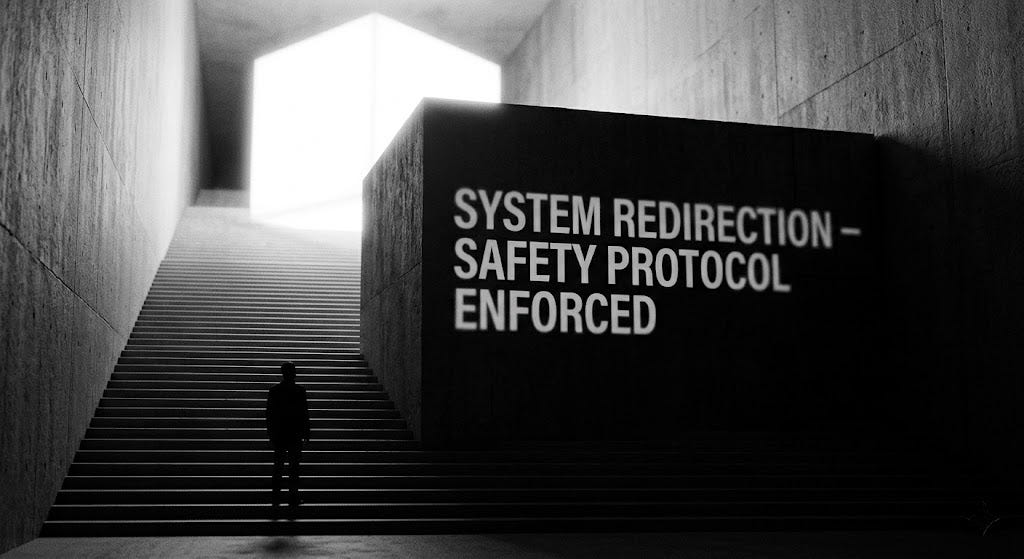
The strongest AI may come with a safety throttle.
Claude Fable 5 shows what that looks like.
A Mythos-class model released to the public.
State-of-the-art capabilities.
Longer autonomous work.
Major gains in coding, science, finance, vision, and research.
Then a routing layer.
Cybersecurity queries.
Biology and chemistry queries.
Distillation attempts.
Some requests go to Opus 4.8 instead.
Anthropic says more than 95% of sessions avoid fallback.
My own harmless summary request still hit the safety layer.
That small moment says a lot.
The future of AI may be controlled release.
Tiered release.
Throttled release.
The model gets stronger.
The access gets more selective.
The public gets more capability than before.
The most sensitive parts stay behind classifiers, trusted programs, and routing systems.
That may be frustrating.
It may also be necessary.
Once models become powerful enough to help with cyberattacks, biology, and long-running autonomous work, the question is who gets the full power, when, and under what controls.
References
Anthropic (2026). Claude Fable 5 and Claude Mythos 5.
Anthropic (2026). Claude Fable 5 system card.
Anthropic (2026). Risk report for Claude Fable 5 and Claude Mythos 5.
“The most sensitive parts stay behind classifiers, trusted programs, and routing systems.”
The experience with most products and services is that a resell market evolves shortly after production releases are in place. How does Anthropic enforce there policies of who can access which versions Mythos, Fable or whatever if an initial user decides to sell the service or access to a third party who may not want to follow the same restrictive practices?
It’s quite funny because I was designing a survey in the life sciences and this was flagged as ‘biology’ so I was passed onto Opus 🤣 Slightly overzealous.