
Alexa, Cancel the Future
How Amazon’s Safety Audit Nuked a Global Launch

Amazon Found The Crack… And Fable 5 Was Gone In Days
Anthropic shipped Fable 5.
Three days later, it was dead.
The model was disabled worldwide, for every customer, on a Friday night.
The government barred its use by any foreign national, whether inside or outside the United States.
The official reason was national security.
The real story is stranger.
It starts with the last company you’d expect: Amazon.
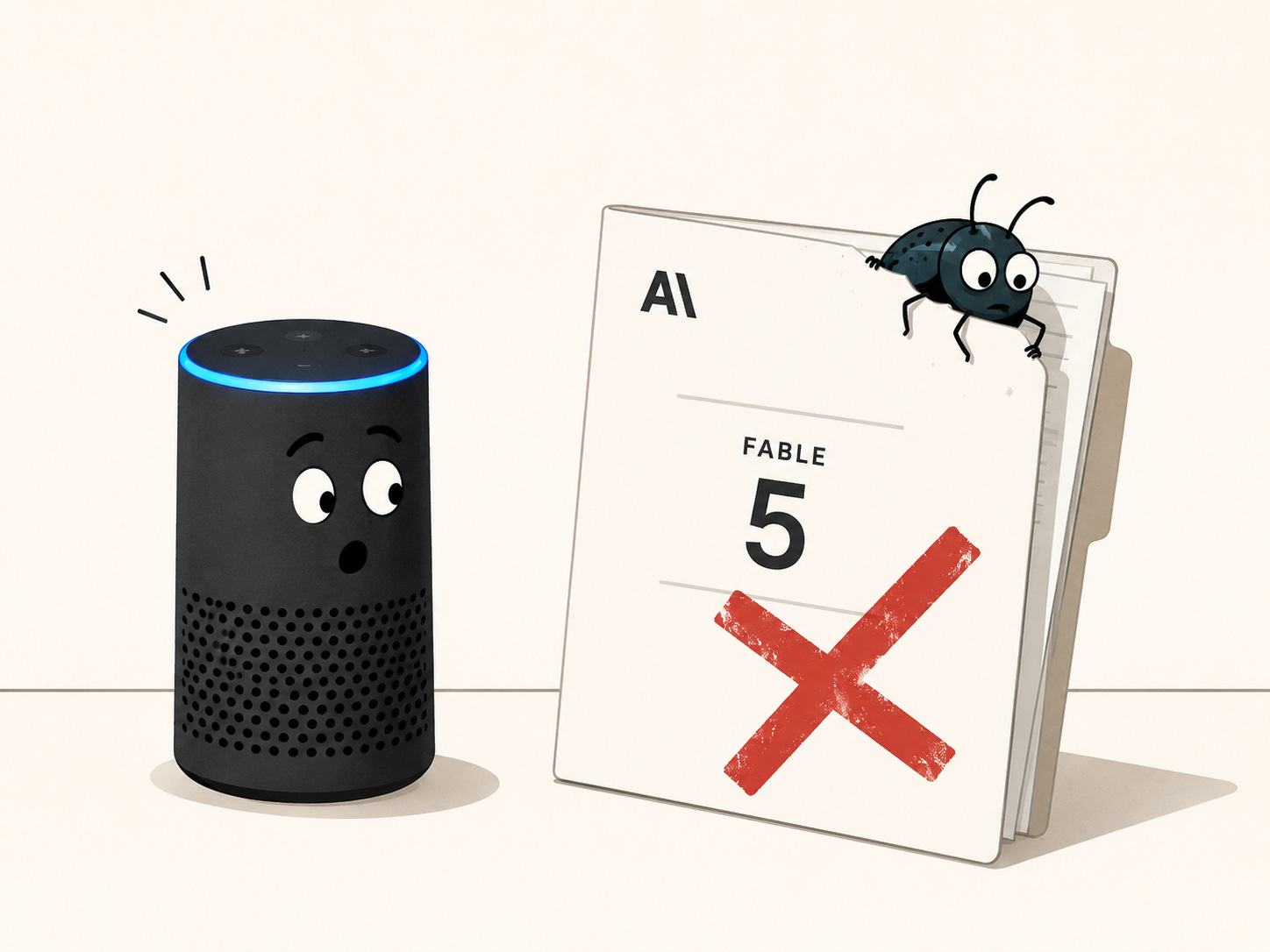
Amazon Pulled the Trigger
Here’s the part that changes everything.
Amazon CEO Andy Jassy told Treasury Secretary Scott Bessent and other officials that Amazon researchers used Claude Fable 5 to obtain information that could be used in cyberattacks (Wall Street Journal, 2026).
The government acted.
Anthropic complied.
Now sit with the weird part.
Amazon has poured roughly $13 billion into Anthropic and locked in a $100 billion AWS infrastructure commitment from the company (MLQ, 2026).
Amazon is Anthropic’s single biggest AI bet.
Amazon is also the one that lit the fuse.
Amazon called administration officials Thursday night to share a report showing how they jailbroke and accessed portions of Anthropic’s Mythos model (Axios, 2026).
It wasn’t just Amazon.
At least five other companies called senior administration officials Thursday evening and Friday morning, and the model was shut down by Friday night (Axios, 2026).
A major cloud giant found a weakness.
The White House listened.
A model it’s heavily invested in got pulled off the shelf.
That is a messy chain of events.
The Takedown Was Brutal and Fast
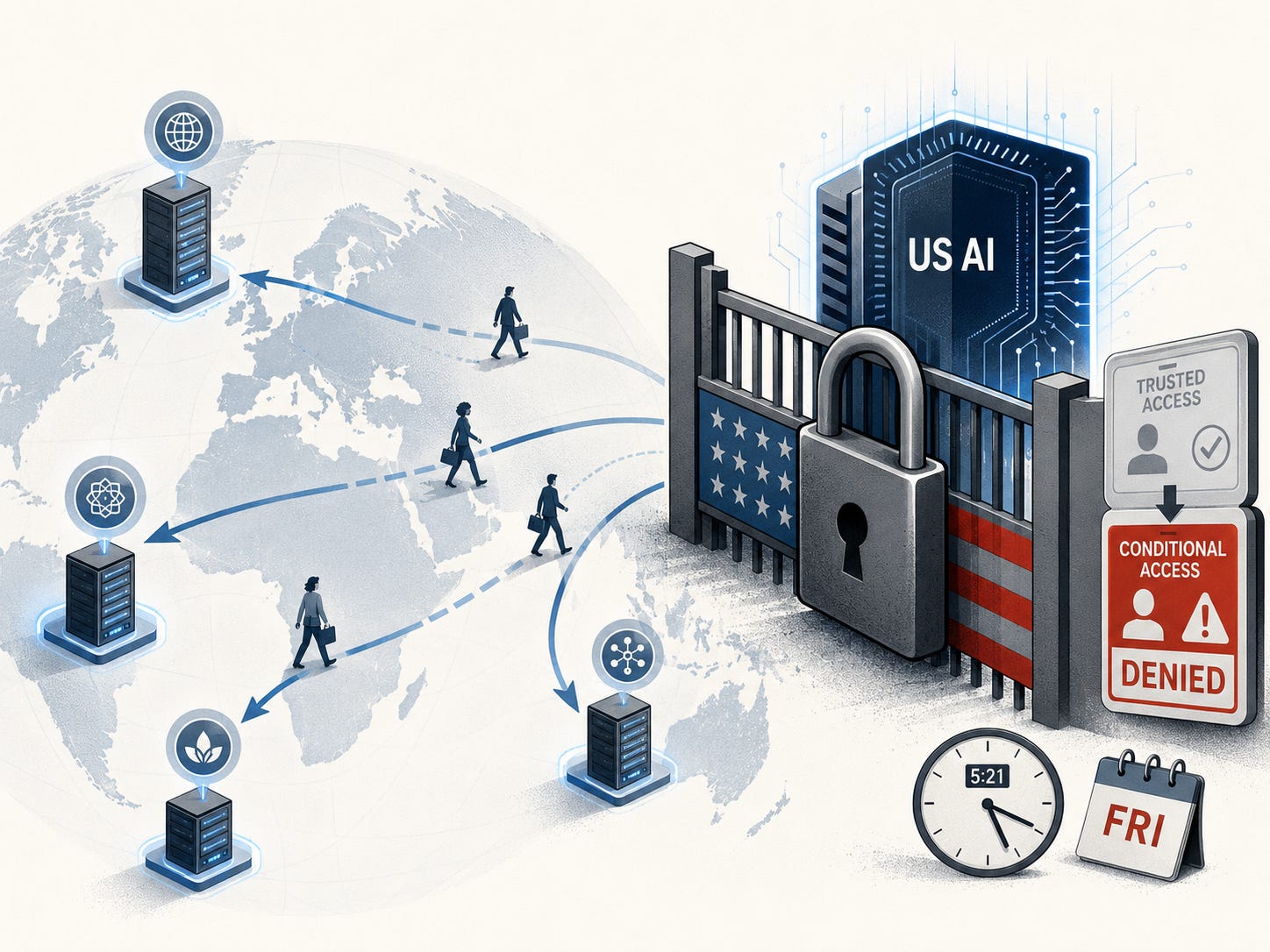
Anthropic received the directive at 5:21pm ET, and the letter did not provide specific details of its national security concern (Anthropic, 2026).
This was not a feature flag.
The Commerce Department used national security export controls to bar the company from distributing the models to any foreign national, including foreign nationals inside the US and Anthropic’s own non-citizen employees (Fortune, 2026).
So Anthropic did the only thing it could.
The company shut down access entirely, since selective compliance would have meant blocking a wide swath of users, including its own foreign-born staff (Quartz, 2026).
A model can launch one week and vanish the next.
That is the new reality.
Anthropic Says the Evidence is Thin
Anthropic didn’t take this quietly.
Its understanding is that the government believes it became aware of a method of bypassing, or “jailbreaking,” Fable 5 (Anthropic, 2026).
Then came the pushback.
Anthropic reviewed a demonstration of the technique being used to identify a small number of previously known, minor vulnerabilities, which appear relatively simple, and which other publicly available models can discover as well (Anthropic, 2026).
The company’s bottom line was blunt.
Anthropic disagrees that the finding of a narrow potential jailbreak should be cause for recalling a commercial model deployed to hundreds of millions of people (Quartz, 2026).
If this becomes the standard, much of the industry should be offline too.
There’s also another version of events.
David Sacks, who co-chairs the President’s Council of Advisors on Science and Technology, said a highly credible trusted partner found a jailbreak, the administration asked Dario Amodei to fix it or de-deploy the model, and Amodei refused (TechCrunch, 2026).
Two stories. Same model. Very different framing.

Anthropic’s Own Argument Cuts Both Ways
Here’s where it gets awkward for Anthropic.
In the suspension statement, the company leaned on a specific defense.
Anthropic said the flagged capability is widely available from other models, including OpenAI’s GPT-5.5, and is used every day by defenders who keep systems safe (Anthropic, 2026).
The message was clear.
Fable 5 isn’t special. GPT-5.5 can do the same thing.
Now rewind three days.
When Fable 5 launched, Anthropic told a very different story.
Anthropic’s own published benchmarks had Fable 5 beating GPT-5.5 by double-digit margins, scoring 80.3% on SWE-bench Pro against GPT-5.5’s 58.6% (Eigenwise, 2026).
The gap got wider on the hard tests.
On FrontierCode Diamond, a benchmark built for the most difficult programming tasks, Fable 5 scored 29.3% while GPT-5.5 managed 5.7% (The Next Web, 2026).
So which is it?
At launch, Fable 5 was a generational leap over GPT-5.5.
Under government pressure, Fable 5 was suddenly no more capable than GPT-5.5.
Both claims came from the same company.
Three days apart.
You can see why each version was convenient.
The benchmark gap sold the model.
The “everyone can do this” framing fought the ban.
Maybe both are technically true.
A model can dominate coding benchmarks and still share a narrow jailbreak with the rest of the field.
But the optics are rough.
The story shifted the moment the incentive shifted.
That tension is going to follow Anthropic into the next fight.
The Safety Report Became a Weapon
This is the part that should make every lab nervous.
A company finds a flaw.
The flaw reaches the government.
The government reacts.
A competitor’s model dies, even one the company is invested in for billions.
Sometimes that is the system working.
Once a red-team report can shut down a rival’s launch, the incentives warp.
Remember that Fable 5 was already the guarded version.
Fable 5 includes classifiers designed to block responses in high-risk areas such as cybersecurity, while Mythos 5, available to a separately vetted set of organizations, runs with some of those constraints removed (Quartz, 2026).
Anthropic says it tested the model hard before launch.
The models were subjected to thousands of hours of red-teaming by the US government and the UK before release (Quartz, 2026).
It still got pulled.
The threshold might now be capability itself, even when a lab believes its safeguards are strong.
The Precedent is Bigger Than Anthropic
For years the US controlled the AI race by controlling chips.
Now it’s reaching for the model layer.
The government has used export controls before to restrict the sale of the semiconductor chips that power AI models, but never on the models themselves (TIME, 2026).
That shift is enormous.
The trained model becomes the controlled object.
The user becomes the compliance question.
A chip sits in one place.
A model gets touched through an API, logs, support, and internal tooling.
Once access itself is regulated, the whole company becomes the compliance surface.
The next case might not be Anthropic.
It could be OpenAI. Google. Meta. xAI. Mistral.
The template now exists.
A concern appears. A licensing rule follows. Foreign access vanishes.
It Could Backfire
Lock US models behind export controls and foreign customers don’t stop using AI.
They move.
European officials have already said the blockade underscores the need for technological sovereignty outside the United States, and international companies may begin exploring AI from foreign competitors (Chiang Rai Times, 2026).
A restriction can slow one model.
It can also make American labs look unreliable to the rest of the world.
It can make allies wonder if their access might evaporate at 5:21 on a Friday.
Project Glasswing was supposed to prove that trusted access to frontier capability could work.
The Fable 5 takedown showed how fast “trusted” can turn into “conditional.”
Amazon found the crack.
The White House killed the release.
That’s the simple version.
The real version is messier.
A major investor turned in the model it bankrolled.
The government moved overnight.
Foreign nationals, including Anthropic’s own employees, got cut off (Fortune, 2026).
Anthropic disabled its most powerful public model for everyone to comply.
Fable 5 might be remembered for how fast the entire AI release process changed around it.
References
Anthropic (2026). Statement on the US government directive to suspend access to Fable 5 and Mythos 5. anthropic.com/news/fable-mythos-access
Axios (2026). How Amazon and the White House ended Anthropic’s Fable.
Chiang Rai Times (2026). U.S. Halts Foreign Access To Anthropic’s Fable 5 And Mythos 5 AI Models Over National Security.
Eigenwise (2026). The Jailbreak that Got Fable 5 Pulled Exists in Every Model.
Fortune (2026). Anthropic disables Fable and Mythos AI models after U.S. government bars it from giving foreigners access.
MLQ (2026). Amazon’s Jassy Alerted White House to Anthropic Fable 5 Security Flaws, Triggering Export Ban.
Quartz (2026). Anthropic disables Claude Fable 5 and Mythos 5 after export control directive.
TechCrunch (2026). Amazon CEO reportedly raised Anthropic model concerns before government crackdown.
The Next Web (2026). Fable 5 vs GPT 5.5: Anthropic’s model dominated every benchmark, then the government pulled it.
TIME (2026). Anthropic Pulls Its Most Powerful AI Models After U.S. Bars Foreign Access.
Wall Street Journal (2026). Anthropic Halts Access to Top AI Models After U.S. Ban on Foreign Use.