
AI Originality
Exploring ChatGPT

Artificial intelligence has made remarkable strides in recent years, excelling in pattern recognition, problem-solving, and even creative fields like art, music, and writing. However, a fundamental question lingers: Can AI create truly original ideas independent of human influence?
At first glance, AI-generated innovations—from paintings to scientific discoveries—suggest that machines might possess creative potential. But when we analyze how AI functions, the distinction between original thought and pattern-based generation becomes critical. In this article, we’ll explore both the scientific and philosophical perspectives on AI’s capacity for originality.
Understanding AI’s Creative Process
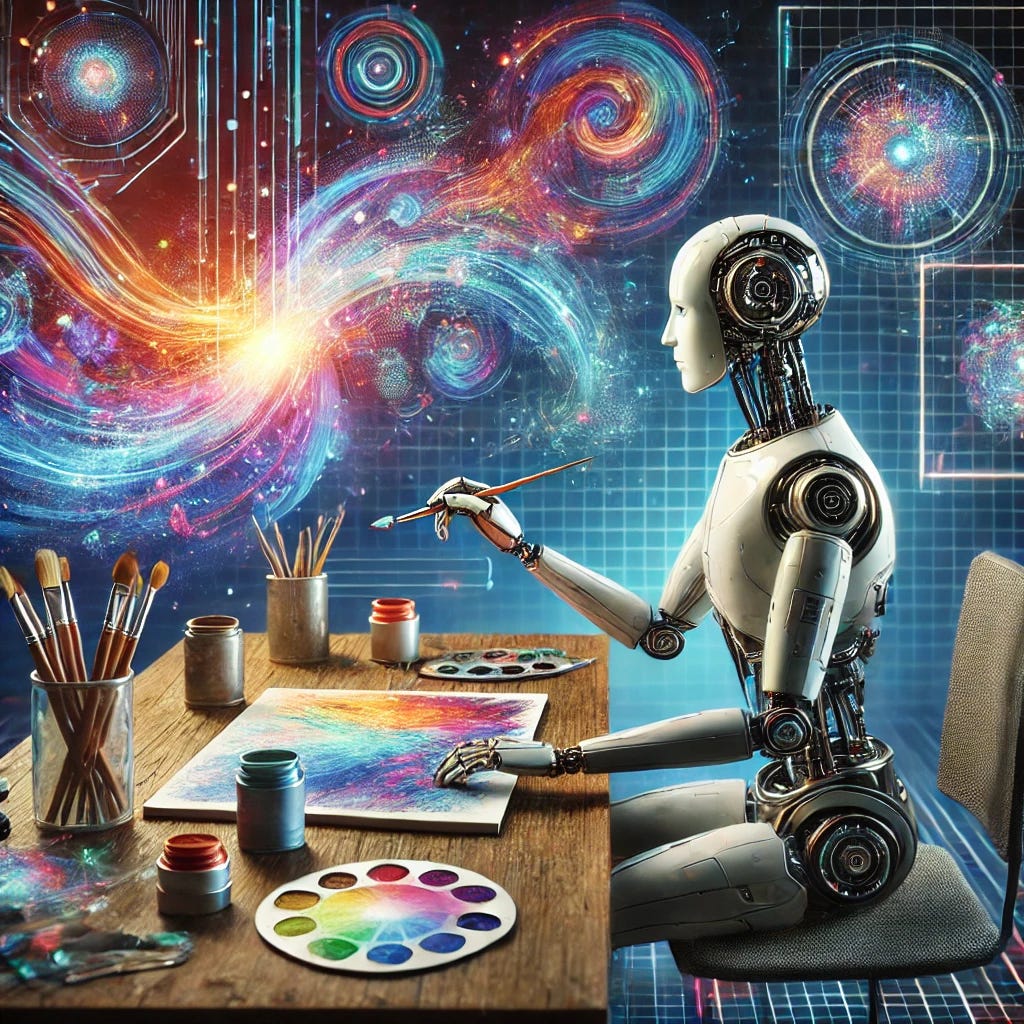
Most AI systems, including deep learning models, function through pattern recognition and data processing rather than independent thought. AI is trained on vast datasets of human-created content, enabling it to generate new outputs that appear original. But is this the same as human creativity, which often involves spontaneity, abstraction, and intuition?
Take GPT models, for example. They predict text based on patterns they have learned from existing human writing. Similarly, AI-powered art generators produce visuals by remixing styles from countless existing artworks. Even in scientific fields, AI excels at identifying patterns and generating novel solutions within predefined parameters—but does that constitute independent ideation?
To better understand this, we must explore how the human mind generates ideas. The philosopher Immanuel Kant argued that creativity stems from the mind’s ability to synthesize concepts in ways that are not purely derivative of past experiences. In contrast, AI lacks self-awareness and does not possess an intrinsic drive to create. Without an independent will or an ability to define its own problems, AI’s creativity is arguably an advanced form of mimicry rather than genuine innovation.
The Philosophical Argument: True Originality or Advanced Imitation?
Philosophically, originality is often tied to conscious experience and intentionality, qualities AI currently lacks. Humans generate new ideas through:
Personal experiences that shape unique perspectives
Abstract reasoning beyond existing data points
Emotional and subconscious processes that influence creative thought
French philosopher Henri Bergson distinguished between mechanical reproduction and creative intuition, arguing that true innovation involves an internal, spontaneous spark that cannot be reduced to computation. Similarly, the German philosopher Martin Heidegger posited that authentic creativity arises from an individual’s engagement with the world, something AI fundamentally lacks.
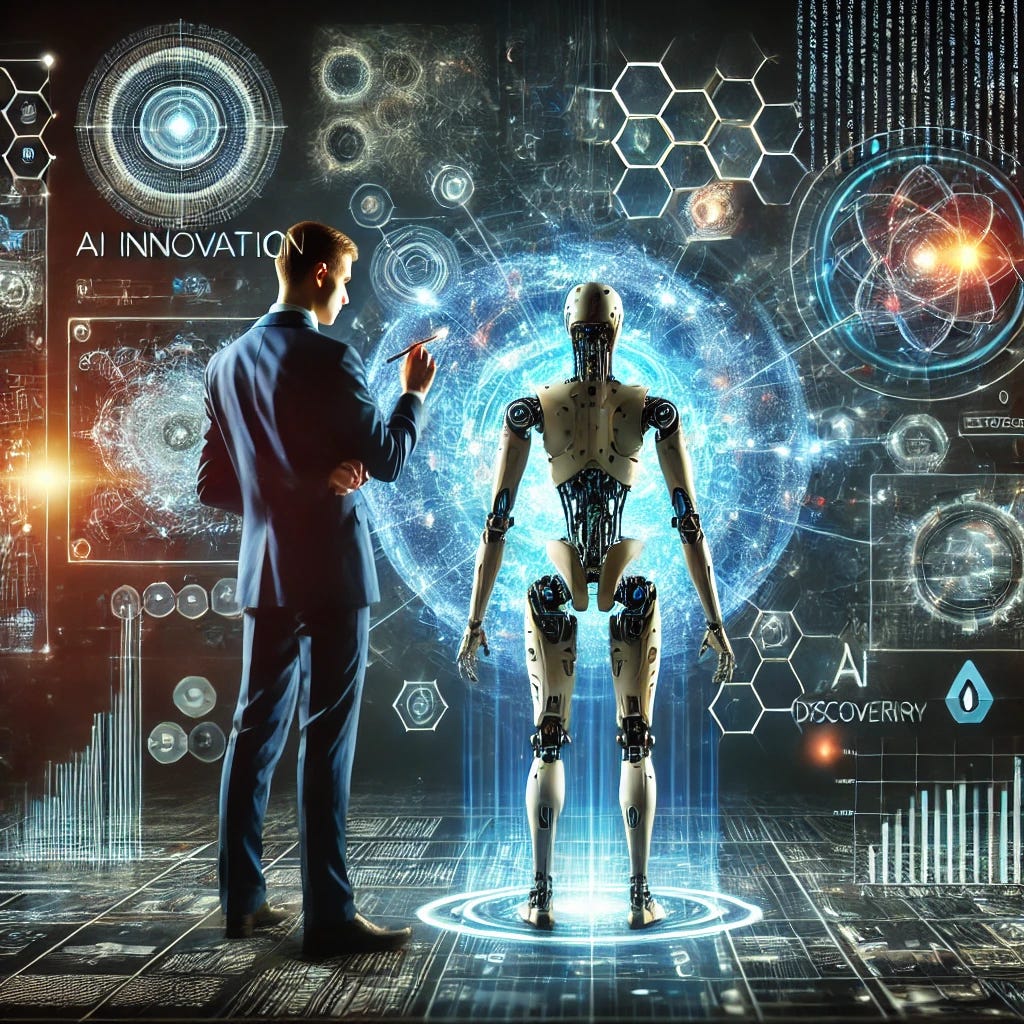
AI, on the other hand, operates within the constraints of its training data. Even when AI generates something unprecedented—such as DeepMind’s AlphaFold predicting protein structures—it is still functioning within human-provided frameworks, goals, and datasets.
Scientific Examples: AI Innovation or Human-Driven Discovery?
1. AI-Generated Art & Music
AI models like DALL·E and AIVA create stunning visual and musical compositions. However, these works are generated by recombining pre-existing elements, rather than through a self-driven imaginative process. While AI can produce works that surprise even their creators, this does not necessarily imply true originality.
2. AI in Scientific Discovery
AI has contributed to medical breakthroughs, such as the aforementioned AlphaFold, which solved a decades-old problem in protein folding. Yet, this achievement was built on human-defined goals and methodologies—AI did not wake up one day and decide to explore protein folding on its own.
3. Algorithmic Innovation
In fields like mathematics and engineering, AI has optimized processes in ways that even experts didn’t anticipate. For example, AI-designed circuit boards by Google’s DeepMind were more efficient than traditional human designs. But again, the problem it solved was one posed by humans, using a framework humans provided.
4. AI in Literature and Storytelling
Some AI systems, such as OpenAI’s GPT-4, can generate compelling short stories, essays, and poetry. However, the underlying process relies on predicting statistically likely word patterns rather than experiencing emotions, interpreting cultural significance, or forming unique worldviews. A novel written by an AI might be coherent and engaging, but it lacks the depth of human experience that informs truly original literature.
Could AI Ever Achieve True Originality?
For AI to generate ideas completely free from human influence, it would need:
Autonomous goals and curiosity – The ability to decide what problems to solve without human prompting.
Abstract thinking – The capacity to connect unrelated concepts in ways that go beyond statistical probabilities.
A form of self-awareness – A machine would need to understand its own creative process and apply unique perspectives to new situations.
Some researchers argue that future self-evolving AI systems—which generate and refine their own code and learning processes—might eventually cross this threshold. However, as of now, AI remains a tool rather than an independent thinker.
A potential pathway for AI to achieve true originality could involve integrating artificial neural networks with biological systems, creating a hybrid intelligence that experiences the world in a way closer to humans. Some theorists propose that quantum computing and neuromorphic engineering could give AI the ability to generate entirely new ideas through unpredictable quantum states and self-modifying neural structures.
However, even with these advances, will AI ever develop subjective experiences? Consciousness, as discussed by philosopher David Chalmers, remains an unsolved “hard problem.” If AI cannot experience the world, can it ever produce ideas in the same way humans do?
AI as a Co-Creator, Not an Independent Genius
While AI has demonstrated incredible capabilities in generating novel outputs, it does so within the boundaries of human-defined parameters. It is an advanced collaborator, an enhancer of human creativity, but not yet an autonomous source of original thought.
True creativity arises from conscious experience, personal agency, and the ability to make meaning beyond raw data. Until AI develops these qualities—if it ever does—its ideas will remain reflections of human knowledge, not independent acts of creation.
Even if AI surpasses human intelligence in many domains, it may remain forever bound to its fundamental nature as a derivative system, building upon the knowledge of its human predecessors rather than generating truly autonomous insights. For now, the greatest creative power still resides within the human mind.
I think we might are classifying AI wrong:
https://theafh.substack.com/p/what-viruses-can-teach-us-about-ai