
AI Isn’t Spreading Like Software
It’s Spreading Like Consulting

It Was Supposed To Scale Cleanly
Software scales cleanly.
You build it once.
Ship it everywhere.
Users log in.
Companies subscribe.
The product spreads.
That was the old model.
And for a while, AI looked like it would follow the same path.
A model.
An API.
A chatbot.
A dashboard.
Something companies could plug in and immediately use.

But That Is Not What Is Happening
The models are powerful.
The demos are impressive.
The benchmarks keep improving.
But inside real companies, AI does not spread like a normal app.
It has to be fitted into workflows.
Connected to messy data.
Adjusted around compliance rules.
Explained to teams.
Tested against real processes.
The technology may be general.
But the implementation is specific.
That is why OpenAI and Anthropic are reportedly moving toward enterprise AI services and acquisitions, not just model releases (Reuters, 2026).
The Bottleneck Is Not Just Intelligence
For the last few years, the AI race looked simple from the outside.
Build the strongest model.
Release it.
Win users.
But enterprise AI is exposing a different problem.
A strong model does not automatically know how a hospital works.
Or a bank.
Or a manufacturer.
Or an insurance company.
Every organization has its own systems.
Its own permissions.
Its own documents.
Its own internal language.
Its own broken processes.
So the real question becomes less:
How smart is the model?
And more:
Can anyone make it useful here?
That Is Why The Services Layer Matters
Anthropic announced a new AI-native enterprise services firm with Blackstone, Hellman & Friedman, and Goldman Sachs, designed to bring Claude into the core operations of mid-sized companies (Anthropic, 2026).
That is not a normal software rollout.
That is implementation work.
Anthropic said the new firm will use applied AI engineers to identify where Claude can have the most impact, build custom solutions, and support customers over time (Anthropic, 2026).
That sounds less like downloading software.
And more like consulting.
Reuters also reported that OpenAI and Anthropic’s joint ventures are looking to acquire AI services firms so they can bring in hundreds of engineers and consultants to help companies put AI models to work (Reuters, 2026).
That tells you something.
The hard part is not only building the intelligence.
It is translating intelligence into operations.
The Model Alone Is Not The Product
A model can answer questions.
But a company does not need answers in the abstract.
It needs invoices processed.
Contracts reviewed.
Customer support improved.
Sales workflows changed.
Claims handled.
Reports generated.
Code maintained.
Decisions routed.
That requires integration.
The model has to enter the company’s machinery.
And that machinery is rarely clean.
From the outside, the technology looks ready.
From the inside, the organization may not be.
The data may be messy.
The workflows may be unclear.
The legal team may be cautious.
The employees may not trust the output.
The systems may not connect.
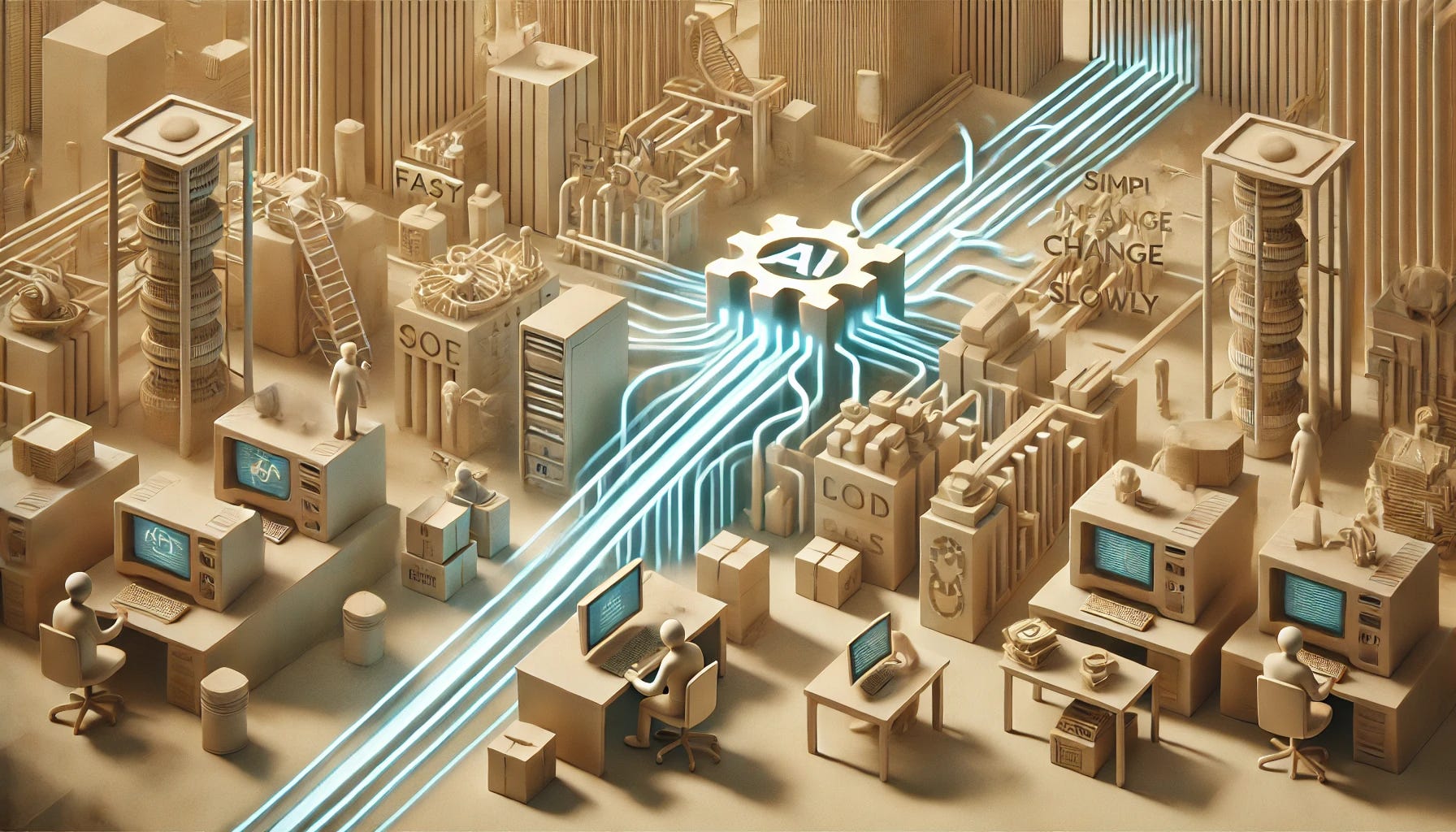
So AI progress moves at two speeds.
The model improves quickly.
The company changes slowly.
That Gap Creates A New Market
A company does not just ask:
Which model should we use?
It asks:
Where should we use it?
Who owns it?
What data can it touch?
What happens if it is wrong?
How does it fit into the workflow?
Who maintains it after launch?
Those are not just software questions.
They are organizational questions.
And organizational questions create services businesses.
TechCrunch reported that Anthropic and OpenAI are both moving into enterprise AI services through joint-venture structures, with Anthropic’s new venture backed by major financial firms and OpenAI preparing a similar effort (TechCrunch, 2026).
That is the signal.
AI is not just being sold.
It is being installed into companies.
Private Equity Makes The Pattern Clearer
The Anthropic venture is not just a lab partnership.
It is backed by firms with access to large networks of portfolio companies.
Blackstone said the new AI services firm will benefit from a consortium network across hundreds of companies, helping design, build, and maintain enterprise AI deployments (Blackstone, 2026).
That is a rollout channel.
Not just a customer list.
A way to push AI through existing business networks.
That makes the model more like consulting at scale.
Find the use case.
Deploy the team.
Integrate the system.
Measure the impact.
Repeat across companies.
This Changes The AI Race
The race is no longer only about who has the best model.
It is also about who has the best deployment machine.
Who can get inside companies.
Who can customize faster.
Who can prove ROI.
Who can build trust with executives.
Who can make AI work with legacy systems.
That is a very different competition.
It favors not just research labs.
But partnerships.
Distribution.
Consultants.
Enterprise relationships.
Operational knowledge.
The best model may not win by itself.
The winner may be the company that makes AI easiest to adopt.
Easiest to trust.
Easiest to integrate.
Easiest to maintain.
The Irony Is Hard To Miss
AI was supposed to reduce complexity.
But selling AI into companies creates more complexity first.
More strategy decks.
More integration work.
More change management.
More internal training.
More consultants.
More hand-holding.
The automation wave may need a human deployment wave before it can scale.
That is the paradox.
The technology that promises to remove work has to be worked into place.
This is not a failure of AI.
It is a sign that the real world is harder than the demo.
A chatbot can answer cleanly.
A company cannot transform cleanly.
Real organizations have history.
Politics.
Regulation.
Bad data.
Old systems.
Human resistance.
AI does not erase those things.
It has to move through them.
And that is why it spreads less like software…
And more like consulting.

AI is not spreading like software.
Software could be shipped.
AI has to be embedded.
It has to enter workflows.
Adapt to company data.
Fit into operations.
Survive compliance.
Earn trust.
That takes people.
Engineers.
Consultants.
Implementation teams.
The strange thing is that the AI revolution may need a lot of human work to arrive.
Not because the models are weak.
But because companies are messy.
And the next phase of AI may not be won only by building the smartest system.
It may be won by knowing how to make that system work inside the real world.
References
Reuters (2026). OpenAI, Anthropic ventures in talks to buy AI services firms.
Anthropic (2026). Building a new enterprise AI services company with Blackstone, Hellman & Friedman, and Goldman Sachs.
Blackstone (2026). Anthropic partners with Blackstone, Hellman & Friedman, and Goldman Sachs to launch enterprise AI services firm.
TechCrunch (2026). Anthropic and OpenAI are both launching joint ventures for enterprise AI services.