
AI Isn’t Just Improving
It’s Joining the Research Team

The Race Used To Be For Users
For most people, the AI race looks simple.
Better chatbots.
Better coding tools.
Better image models.
Better agents.
More features.
More integrations.
That is the public version of the race.
The one users can see.
But the deeper race may be happening somewhere else.
The race of what AI can do for AI itself.

The Shift Researchers Are Watching
A 2026 paper interviewed 25 leading AI researchers from frontier labs and academia, including people from Google DeepMind, OpenAI, Anthropic, Meta, UC Berkeley, Princeton, and Stanford (Field, Douglas, & Krueger, 2026).
The core concern was not only that AI systems will become better assistants.
It was that AI systems could begin automating AI research and development itself.
That means coding.
Experiment design.
Model evaluation.
Architecture search.
Debugging.
Research iteration.
The kind of work that improves future models.
That Changes The Feedback Loop
Right now, humans build AI.
Researchers design experiments.
Engineers write code.
Labs test models.
Then the next system improves.
But if AI starts doing more of that work, the loop changes.
AI helps build better AI.
Better AI helps build even better AI.
That is why this question matters.
It is not just another use case.
It is AI entering its own improvement cycle.
The Concern Is Not Fully Hypothetical
The paper found that AI systems have not yet achieved recursive self-improvement.
That matters.
We are not there.
But 20 of the 25 researchers interviewed still identified automating AI research as one of the most severe and urgent AI risks (Field, Douglas, & Krueger, 2026).
That does not mean all of them agreed on timelines.
They did not.
But they agreed enough that the direction is no longer fringe.
The concern is moving from speculation…
To frontier-lab discussion.
The Public May Not See This First
This is the part that makes the race different.
The most important AI research tools may never appear as public products.
The same 2026 paper found that 17 of the 25 researchers expected advanced coding or AI R&D systems to become increasingly reserved for internal use by AI companies or governments (Field, Douglas, & Krueger, 2026).
That makes sense.
If a system can meaningfully accelerate AI development, it becomes strategically valuable.
You do not release that casually.
You use it internally.
To move faster.
To widen the gap.
To build the next system before anyone else can.
The Frontier Becomes Less Visible
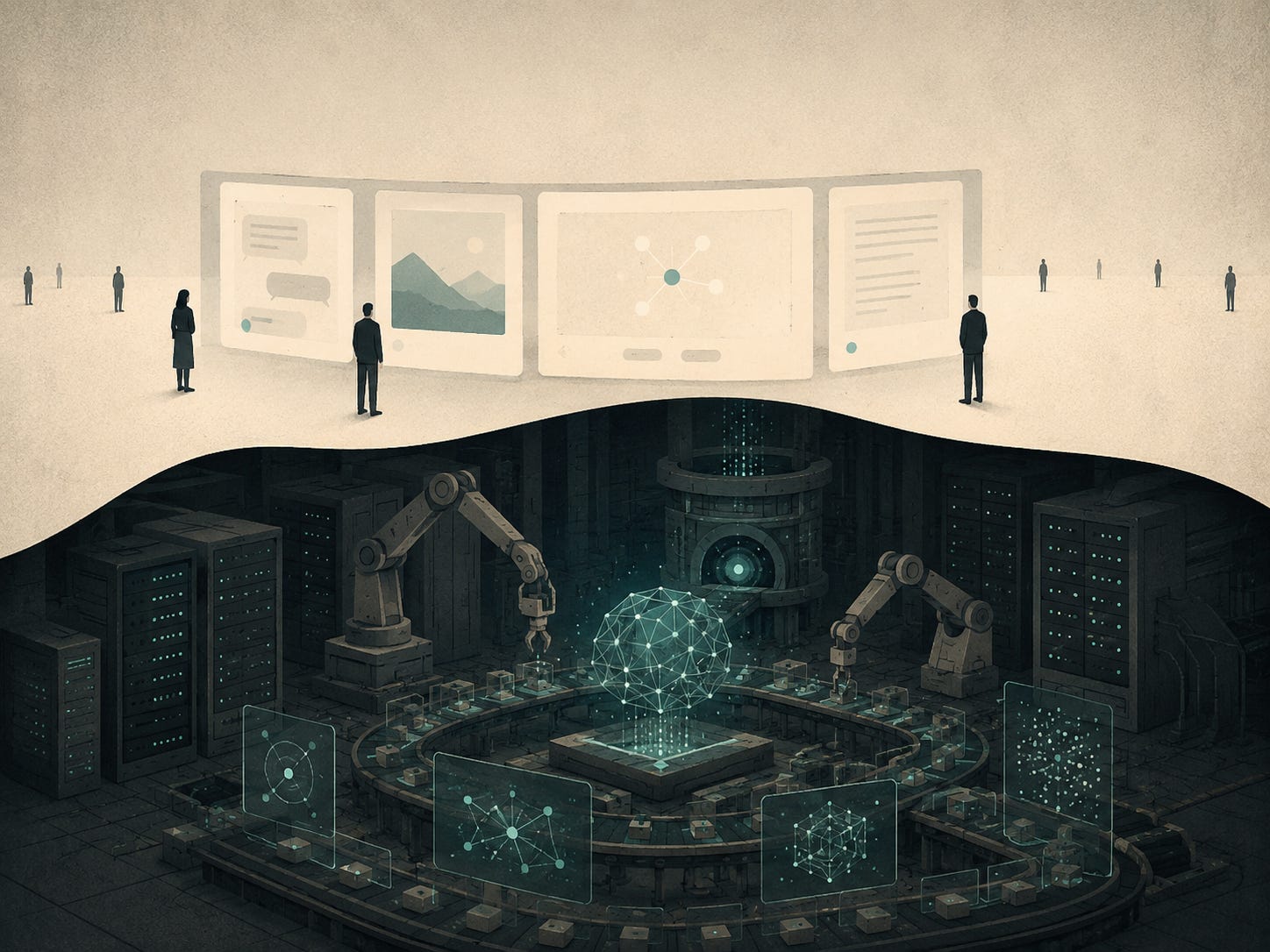
The public sees the chatbot.
The lab sees the research assistant.
The public sees the release.
The lab sees the internal system improving the next release.
That creates a strange split.
The product may not show the full race.
The real competition may be happening inside model labs.
Inside private coding environments.
Inside internal evaluation pipelines.
Inside systems designed to automate the work of making systems.

AI R&D Is Different From Other Automation
Automating customer support is one thing.
Automating legal drafting is one thing.
Automating coding is already more important.
But automating AI research is different.
Because it can feed back into itself.
A customer support bot does not usually build the next generation of customer support bots.
But an AI research agent could help build the next generation of AI research agents.
That is why people talk about recursive improvement.
The output becomes part of the engine.
This Is Where The Race Gets Faster
The bottleneck in AI progress has always included human research speed.
How fast teams can test ideas.
How fast they can read papers.
How fast they can run experiments.
How fast they can debug failures.
How fast they can interpret results.
If AI reduces those bottlenecks, progress may accelerate.
Not because one model suddenly becomes magic.
But because the process of improvement gets compressed.
A 2025 paper on autonomous AI development argued that systems capable of significantly automating or accelerating AI R&D may need explicit safeguards before they are widely deployed (Clymer et al., 2025).
That is a sign of where the safety conversation is going.
Not only what AI does.
But what AI helps create next.
The Scientist Itself Is Becoming Automated
This is already being explored beyond AI labs.
A 2026 Nature paper introduced “The AI Scientist,” a pipeline aimed at automating the research life cycle from idea generation to experimentation, paper writing, and review (Nature, 2026).
That is not the same as fully automating frontier AI research.
But it points in the same direction.
Research is becoming a workflow that AI can partially enter.
Hypotheses.
Experiments.
Code.
Analysis.
Writing.
Review.
The more of that loop AI touches, the more research itself becomes machine-assisted.
The Hard Part Is Control
A system that helps research faster is useful.
Very useful.
But the more autonomy it has, the more important oversight becomes.
What experiments does it choose?
What shortcuts does it take?
What goals does it optimize?
What mistakes does it repeat?
What results does it overvalue?
What risks does it ignore?
Clymer and colleagues argued for minimum safeguards around autonomous AI development, including explicit human approval and restrictions on systems improving themselves or other AI systems without oversight (Clymer et al., 2025).
That point is important.
The danger is not only that AI research gets faster.
It is that it gets faster before governance knows where the brakes are.
This Is Not Just About Intelligence Explosion
That phrase gets attention.
And it matters.
But the more immediate issue may be simpler.
Lab advantage.
If one company gets better internal AI researchers before others do…
It can run more experiments.
Ship faster.
Lower costs.
Improve models faster.
Recruit better.
Raise more capital.
Build the next toolchain.
The lead compounds.
Even without a dramatic “takeoff,” AI-assisted R&D could make the strongest labs harder to catch.
That Could Reshape The Whole Industry
If AI research automation stays internal, the AI market may become less open.
Not because users lose access to chatbots.
But because the systems that make the next models are hidden.
The public sees outputs.
A few labs control the acceleration machinery.
That changes competition.
It changes transparency.
It changes what governments may want to inspect.
It changes what “frontier” even means.
The frontier is no longer only the model.
It is the model plus the system that builds the next one.
The real AI may be the race to automate AI research itself.
Humans build AI.
Then AI helps build better AI.
Then better AI helps build the next system faster.
That does not mean recursive self-improvement has arrived.
But the direction is clear enough that researchers are already warning about it.
The public sees AI as a tool.
Labs may increasingly use it as a builder.
And once AI becomes part of building the next AI…
The race changes.
References
Field, S., Douglas, R., & Krueger, D. (2026). AI Researchers’ Views on Automating AI R&D and Intelligence Explosions. arXiv.
Clymer, J., Duan, I., Cundy, C., Duan, Y., Heide, F., Lu, C., Mindermann, S., et al. (2025). Bare Minimum Mitigations for Autonomous AI Development. arXiv.
Nature (2026). Towards end-to-end automation of AI research.
“And once AI becomes part of building the next AI…
The race changes.”
the terrifying and exciting moment. and it’s mostly likely upon us soon. 🔥
AI can't reason, at least the models we have so far. LLM's will improve and self improve but without world models there are hard walls as to what the can accomplish. AMI Labs and World Model. We will see results in < 1year