
AI Ethics Says Slow Down
The Military Says Speed Up

AI Ethics Used To Sound Civilian
Bias.
Privacy.
Misinformation.
Jobs.
Surveillance.
Education.
Those questions still matter.
But the debate is moving somewhere harder.
War.
Because once AI enters military systems, the stakes change.
The question is no longer only whether a model gives a bad answer.
It is whether AI changes who gets watched.
Who gets targeted.
Who gets attacked.
And how fast those decisions happen.
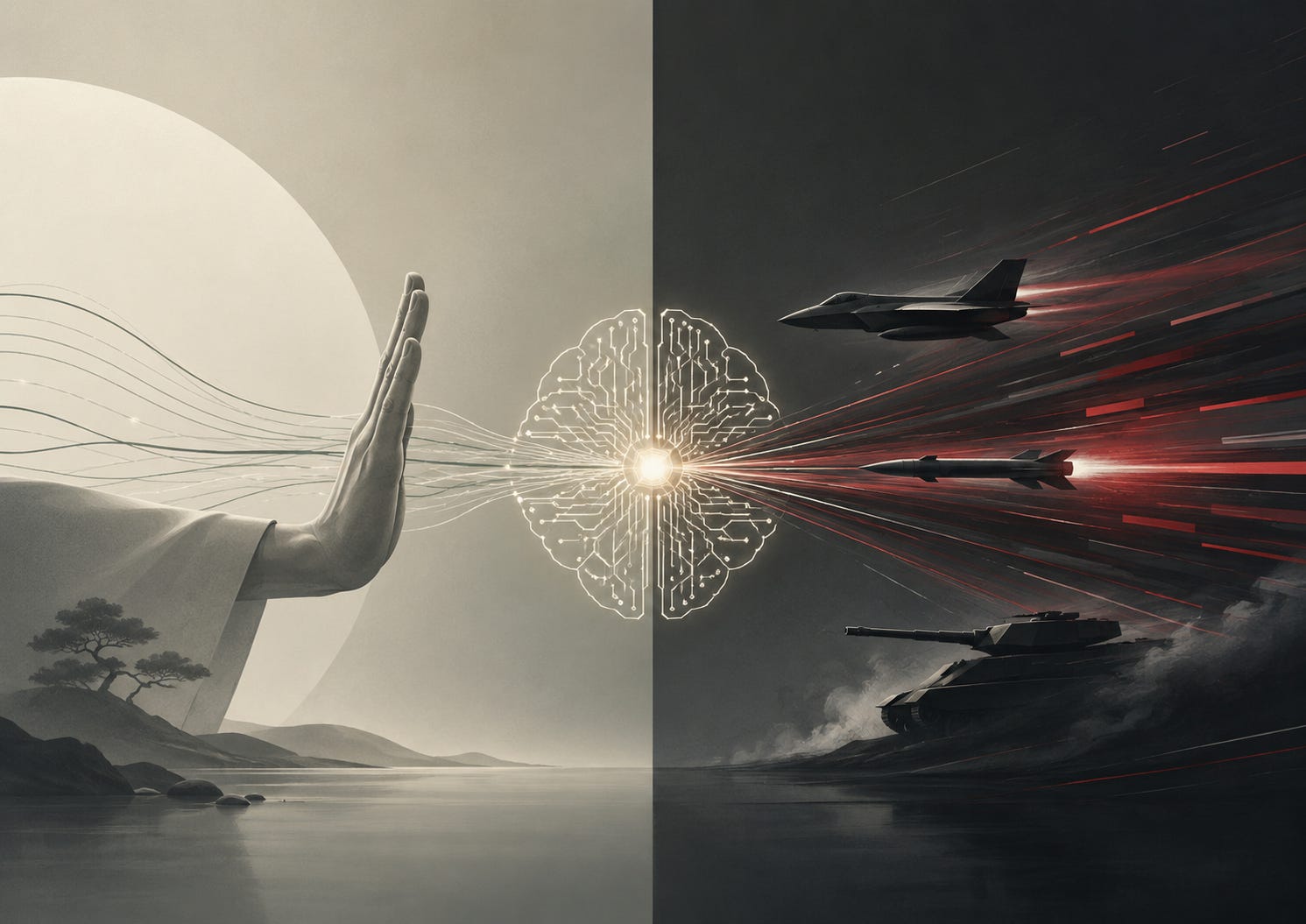
That Is Why The Current Military Debate Matters
The Pentagon is pushing harder into battlefield AI, while some military leaders are warning that the technology still needs caution, oversight, and human judgment.
At a special forces conference in Tampa, Adm. Frank Bradley of U.S. Special Operations Command warned about unintended consequences and emphasized careful deployment and human oversight in AI-driven targeting (AP, 2026).
At the same time, Defense Secretary Pete Hegseth has argued for aggressive AI adoption in warfare, free from what he described as ideological constraints (AP, 2026).
That is the split.
One side sees speed as the advantage.
The other sees speed as the danger.
The Military Incentive Is Obvious
War rewards speed.
Faster intelligence.
Faster targeting.
Faster coordination.
Faster decisions.
Faster response.
If an adversary is using AI to move faster, the pressure to adopt AI becomes intense.
No military wants to be slower than the other side.
That is why the argument for military AI is so powerful.
It is not only about innovation.
It is about survival.
If the enemy uses AI, refusing to use it can start to look irresponsible.
That is how the race begins.
Ethics Starts From A Different Place
Ethics does not begin with speed.
It begins with limits.
What should not be automated?
What should not be delegated?
What should require human judgment?
What happens when a system is wrong?
Who is accountable when the machine compresses the decision?
That is why the Vatican’s recent AI statement matters.
Pope Leo XIV urged stronger regulation of AI and warned that some weapons systems are increasingly operating beyond human control (Reuters, 2026).
That is a direct challenge to the military logic of acceleration.
The moral question is not only whether AI makes war more efficient.
It is whether making war more efficient makes war easier.
The Dangerous Word Is “Assist”
Military AI is often described as decision support.
Assisting analysts.
Assisting commanders.
Assisting targeting.
Assisting battlefield awareness.
That sounds safer than autonomy.
But assistance can still change the decision.
If the AI filters what a person sees…
Ranks threats…
Recommends targets…
Speeds up the kill chain…
Then the human may still be “in the loop” technically.
But the shape of the decision has already changed.
The model has narrowed the world before the human acts.
Human Oversight Can Become Symbolic
This is the hardest part.
Everyone says there should be a human in the loop.
But what does that mean when decisions happen faster?
If the system processes more information than a human can inspect…
If the recommendation arrives with confidence…
If the commander has seconds to decide…
If rejecting the system feels like slowing the mission…
Then human oversight can become thin.
A person may approve the action.
But approval is not the same as meaningful control.
Recent work on military human-robot interaction argues that the traditional idea of “meaningful human control” may be insufficient in military contexts and proposes “meaningful human command” as a stronger model for AI-enabled military systems (Hepworth et al., 2026).
That distinction matters.
A human nearby is not enough.
The human has to retain real authority.

The Pentagon Already Knows This Boundary Matters
U.S. policy on autonomous weapons has long centered on human judgment.
The Department of Defense’s Directive 3000.09 says autonomous and semi-autonomous weapon systems must be designed to allow commanders and operators to exercise appropriate levels of human judgment over the use of force (U.S. Department of Defense, 2023).
That sounds reassuring.
But the word “appropriate” is doing a lot of work.
Appropriate in what context?
For what weapon?
At what speed?
With what level of explanation?
Against what kind of target?
Military AI makes those questions harder.
Because the faster the system moves, the more pressure there is to redefine what counts as enough human judgment.
This Is Where The Moral And Military Worlds Collide
The moral world says slow down.
Ask what should never be delegated.
Protect human dignity.
Do not let machines normalize violence.
The military world says speed up.
Do not fall behind.
Use the tools adversaries are using.
Compress the decision cycle.
Protect soldiers.
Win the fight.
Both sides can claim they are protecting lives.
That is what makes the debate so difficult.
Restraint can protect civilians.
Speed can protect soldiers.
But speed can also lower the threshold for force.
And restraint can look like strategic weakness.
AI Could Lower The Cost Of Violence
This is one of the deepest concerns.
If AI makes targeting easier…
If drones become cheaper…
If surveillance becomes constant…
If decisions become faster…
Then war can become easier to start, expand, or sustain.
Pope Leo warned that AI could lower ethical boundaries in warfare, depersonalize victims, and normalize conflict by turning human beings into data points inside automated systems (Reuters, 2026).
That is not a technical objection.
It is a human one.
War is already dangerous enough when humans make the decisions.
AI may make it more efficient.
But efficiency is not the same as morality.
The Public May Be More Permissive Than People Assume
There is another uncomfortable layer.
Public opinion may not simply reject military AI.
A 2026 survey of 9,000 respondents across nine countries found that support for military AI varies by scenario, with unease concentrated most strongly around fully autonomous lethal force rather than all military AI uses (Jungherr, Schlude, & Rauchfleisch, 2026).
That means the politics may be complicated.
People may oppose killer robots in theory.
But support AI for surveillance.
Defense.
Logistics.
Target assistance.
Cyber operations.
Or systems that keep their own soldiers safer.
So the line may not be public acceptance versus public rejection.
It may be which uses seem acceptable before people understand how they connect.
The Tech Companies Are Caught In The Middle
This is why the Anthropic-Pentagon dispute matters.
AP reported that Anthropic raised ethical concerns about autonomous drones and surveillance, leading to a legal fight after the company lost a major contract and was labeled a supply chain risk (AP, 2026).
That story is important because it shows the new pressure on AI labs.
A company can claim safety values.
But national-security customers may want fewer restrictions.
If the company resists, it risks losing contracts.
If it complies, it risks becoming part of military escalation.
That is the bind.
AI companies are not just selling software anymore.
They are being pulled into state power.
The Question Is Not Whether Militaries Will Use AI
They already are.
The real question is where the line gets drawn.
Intelligence analysis?
Logistics?
Cyber defense?
Target recognition?
Drone swarms?
Autonomous weapons?
Nuclear command support?
Some uses may be defensible.
Others may be unacceptable.
But the line cannot be left vague forever.
Because if the line is vague, speed will define it.
And speed usually moves in the direction of more automation.
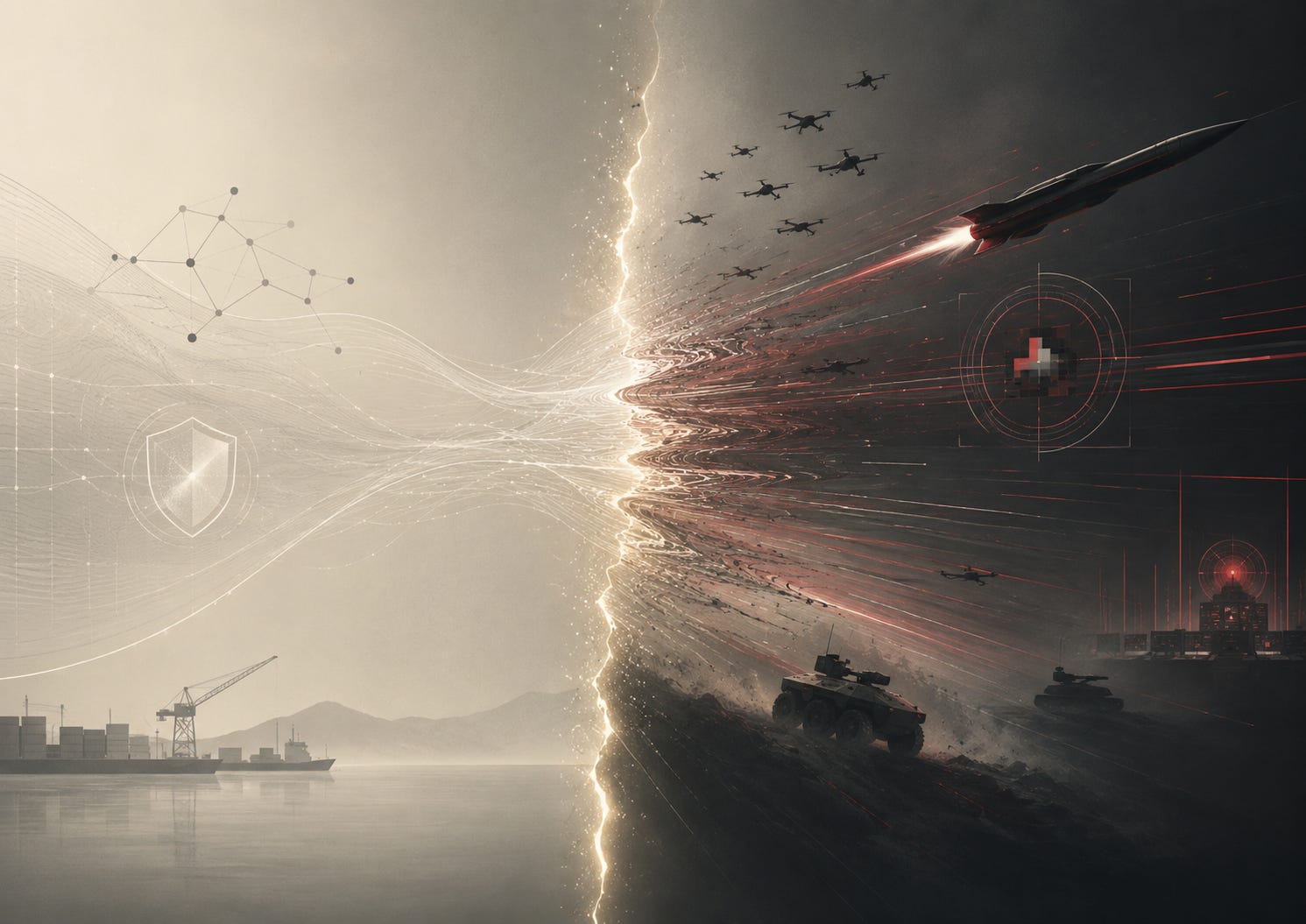
AI ethics says slow down.
The military says speed up.
That tension may define the next phase of AI.
The people warning about AI weapons are afraid of war becoming faster than moral judgment.
The people pushing military AI are afraid of falling behind adversaries who will not wait.
That is why this debate is so hard.
Both sides are responding to real risks.
But they prioritize different ones.
And once AI enters the battlefield, the old language of “human in the loop” may not be enough.
The real question is whether humans still have meaningful command…
Or whether they are simply approving decisions that machines have already made too fast to question.
References
Associated Press (2026). As the Pentagon pushes for battlefield AI, some military leaders urge caution.
Reuters (2026). Pope, urging AI regulation, warns some weapons now beyond human control.
Reuters (2026). Quotes from Pope Leo’s document warning world of AI risks.
U.S. Department of Defense (2023). Directive 3000.09: Autonomy in Weapon Systems.
Hepworth, A., Assaad, Z., Wyatt, A., & Abbass, H. (2026). Meaningful Human Command: Towards a New Model for Military Human-Robot Interaction. arXiv.
Jungherr, A., Schlude, A., & Rauchfleisch, A. (2026). Beyond Killer Robots: General AI Attitudes and Public Support for Military AI in Nine Countries. arXiv.
The point about “assist” is the one that ought to keep people up at night. I spend my working life at the far less dramatic end of this, building AI systems to monitor disinformation and information threats, and the pattern you describe turns up long before anyone reaches for a weapon. The moment a model decides what a human sees first, ranks it, and hands it over with a tidy confidence score, the decision has quietly already been made. The person is left ratifying a judgement reached at a speed they cannot actually audit. We have been politely calling that “human in the loop” for years. It has always been nearer to a human at the exit. The military version is simply the same problem with the safety catch off.
side note: great graphic on this one