
Aaaand It's Gone
Amazon Hands Claude The Corporate Credit Card And Torches Two Million Dollars

Stan Marsh walks into a bank carrying money his grandmother gave him.
The banker moves it through a series of ridiculous investments, taps a few buttons, and announces that the money has disappeared.
“Aaand it’s gone.”
Amazon recently produced the corporate AI version of that scene.
The company attempted to use Anthropic’s Claude Sonnet to match information about authors with product listings on its retail platform. The project reportedly failed to launch successfully. It still accumulated a $1.8 million bill, exceeded its budget by 860%, and continued for five months before the cost overrun was detected (Financial Times, July 30, 2026).
Amazon engineers presented the case during an internal meeting about the financial risks of using AI models at scale. Staff warned that mistakes which once produced relatively cheap software problems could become “catastrophically expensive” when they triggered enormous volumes of paid model calls (Financial Times, July 30, 2026).
Amazon described the cases as isolated experiments that are helping the company improve its systems. Engineers are now developing automated guardrails intended to catch runaway spending sooner (Financial Times, July 30, 2026).
The wider lesson reaches far beyond Amazon.
Corporate America spent the past few years asking employees to use more AI.
The bills have started arriving.

The Million-Dollar Typo
Traditional software can waste enormous amounts of money.
A coding mistake can crash a service, expose data, consume unnecessary computing resources, or send a cloud bill through the roof.
Generative AI adds another meter.
Companies commonly pay according to the amount of information a model processes and generates. These units are called tokens. Long prompts, large documents, lengthy answers, repeated retries, and conversations between several agents can all increase the final cost (Associated Press, July 28, 2026).
One model request may cost very little.
Automation changes the scale.
An employee asks Claude to complete a task once.
An agent may perform the task hundreds of times, inspect its own output, request more information, call another tool, rewrite the answer, and repeat the process after each failure.
The original mistake remains inside the workflow.
The meter keeps running.
Amazon engineers reportedly warned that AI-assisted code migrations could become extremely expensive when small implementation errors caused models to be called repeatedly. The author-matching project continued consuming resources for months before the financial damage became clear (Financial Times, July 30, 2026).
A human worker has natural limits.
They become tired.
They get bored.
They eventually ask why they are still doing something that makes no sense.
An AI agent can continue working with extraordinary enthusiasm.
It feels no embarrassment when the same approach fails for the hundredth time.
It never looks at the invoice.
Amazon Had More Than One Surprise
The author project was the largest example presented to Amazon employees.
It was not the only one.
Another initiative reportedly created around $541,000 in unexpected spending while developing financial-auditing tools. A separate logistics project intended to improve delivery speeds accumulated approximately $134,000 in costs before it was detected after more than two weeks (Financial Times, July 30, 2026).
Amazon emphasized that these cases do not represent the performance of its entire AI program. The company views them as lessons from experimentation rather than proof that its broader AI strategy has failed (Financial Times, July 30, 2026).
They still show how quickly spending can escape ordinary oversight.
A department approves an experiment.
An engineer connects an expensive model.
The system begins handling real workloads.
Usage expands.
Someone assumes the bill remains close to the original estimate.
Five months later, the finance department discovers that the experiment has become a seven-figure customer of Anthropic.
The old software world produced cost overruns too. Cloud computing created entire careers around locating forgotten servers, oversized databases, and unused services quietly charging companies every month.
AI accelerates that problem.
A cloud server can sit idle.
An agent can actively generate more work for itself.
It can create a report, critique the report, rewrite the report, produce tests for the rewritten report, and ask another agent to review the tests.
Every step looks productive on a dashboard.
The business may still have nothing useful at the end.
Welcome to Tokenmaxxing
Amazon’s spending problem arrived after another strange internal experiment.
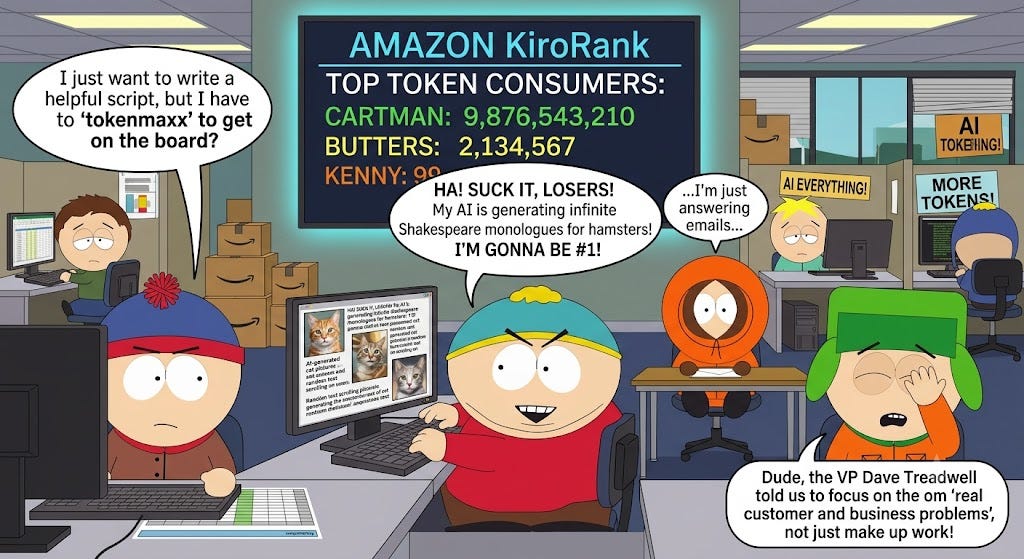
Employees created an informal leaderboard called KiroRank that tracked usage of the company’s AI development tools. Workers could compare how many tokens they consumed with the totals generated by their colleagues (Business Insider, May 2026).
Some employees reportedly assigned AI systems trivial or unnecessary tasks to improve their positions. Amazon later shut down the leaderboard. Senior vice president Dave Treadwell told workers to focus on real customer and business problems instead of using AI simply to increase usage (Business Insider, May 2026).
The leaderboard and the $1.8 million project were separate events.
They grew from the same corporate instinct.
Amazon wanted rapid AI adoption.
Managers needed a way to measure it.
Token consumption was easy to count.
Business value was harder.
Employees responded to the visible metric.
This happens inside every large organization.
Measure sales calls and workers make more calls.
Measure emails and they send more emails.
Measure lines of code and programmers produce bloated software.
Measure AI tokens and employees find reasons to consume tokens.
The behavior received a name.
Tokenmaxxing became a Silicon Valley status symbol as some companies treated heavy AI consumption as evidence that workers had embraced the future. The fad has since faced resistance as businesses report rising costs without comparable improvements in productivity (Associated Press, July 28, 2026).
The metric rewarded activity.
The invoice measured that activity perfectly.
The productivity remained harder to locate.
The Machine Produces Receipts
AI generates an enormous amount of visible work.
It writes code.
It creates meeting summaries.
It produces reports, support tickets, presentations, emails, tests, documentation, and project plans.
A manager can open a dashboard and see thousands of completed actions.
That activity feels substantial.
Someone still has to determine whether any of it needed to happen.
A weekly report may now contain twenty pages instead of three.
The extra seventeen pages may consume management time without improving a single decision.
An AI coding agent may generate thousands of lines of software.
Human engineers may spend days reviewing, correcting, and removing them.
An automated research system may produce hundreds of summaries.
Nobody reads them.
Corporate AI can create its own version of busywork.
The machine performs tasks faster, which makes it easier to create tasks with little value.
Companies are becoming more cautious about using raw token consumption as a measure of progress. Businesses are shifting toward cheaper systems, model routing, and more deliberate deployment as the relationship between AI usage and real productivity remains uncertain (Associated Press, July 28, 2026).
Microsoft CEO Satya Nadella and Palantir CEO Alex Karp have also warned against treating indiscriminate token spending as evidence of economic value (Associated Press, July 28, 2026).
The technology can still create enormous value.
Management has to find it.
AI may produce ten times as much work.
The company needs to know which tenth mattered.
The Agent Cannot Feel the Bill
Most employees understand that money is limited.
They may waste time or make poor decisions, though they generally recognize that another week of work requires another week of salary.
An AI agent has no comparable intuition.
It receives an objective.
Match these records.
Fix this code.
Research this market.
Optimize this delivery route.
The agent attempts to complete the assignment within the permissions it has been given.
Cost exists outside its experience.
A model can understand a sentence explaining that tokens are expensive. That knowledge does not create the discomfort a person feels while watching money disappear.
The agent needs explicit financial boundaries.
A maximum number of model calls.
A spending limit.
A deadline.
A cheaper fallback model.
Human approval before an expensive action.
An automatic shutdown when repeated attempts stop improving the result.
Amazon is developing automated spending guardrails after discovering how long some projects could operate before their expenses attracted attention (Financial Times, July 30, 2026).
These controls will become essential as agents receive more autonomy.
A chatbot waits for a person to send another message.
An agent can plan, execute, inspect the result, and decide what to do next.
That autonomy creates much of the promised economic value.
It also allows spending to continue without a human pressing the button each time.
The agent may be working exactly as designed.
The design may be financially insane.
Corporate AI Gets an Allowance
The next phase of enterprise AI will look less exciting.
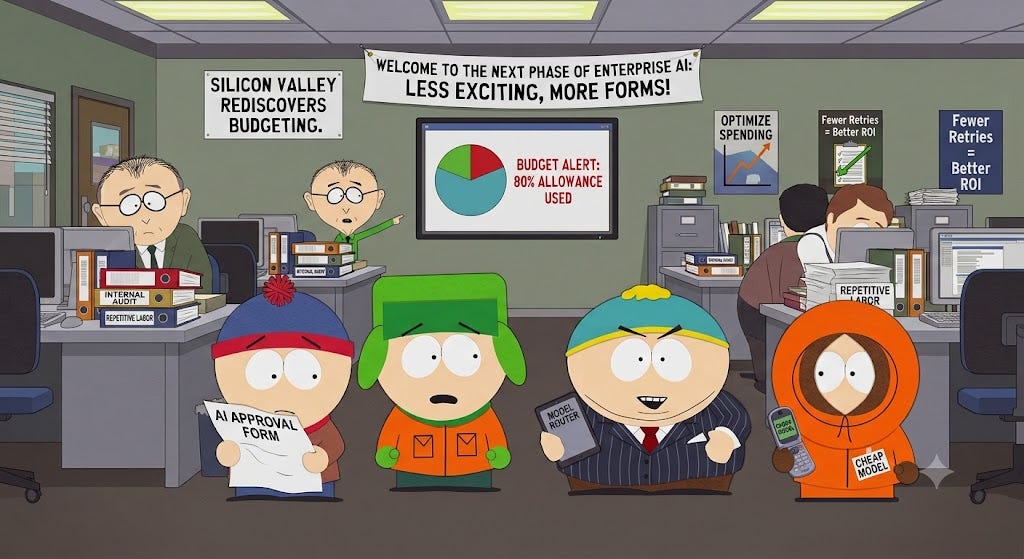
It will involve budgets, approval forms, cost dashboards, internal audits, and people whose job is to tell the brilliant autonomous agent that it has used up its allowance.
Companies are already experimenting with model routing.
Routine tasks can be sent to smaller and cheaper systems. Difficult planning and analysis can be reserved for expensive frontier models. Open-weight systems can handle workloads that businesses are comfortable running on their own infrastructure (Associated Press, July 28, 2026).
The strongest model will no longer receive every request automatically.
It may become the executive consultant of the AI workforce.
Cheaper models will perform the repetitive labor.
Businesses are also paying more attention to shorter prompts, smaller context windows, cached information, fewer retries, and closer monitoring. The goal is to obtain a useful answer without paying a frontier model to reread the history of the company every time someone asks a question.
The wider corporate movement has shifted away from tokenmaxxing and toward cheaper models, spending controls, and more selective usage. Companies are beginning to reserve premium systems for tasks where the additional intelligence justifies the additional expense (Associated Press, July 28, 2026).
Some companies are taking the budget metaphor literally.
Atlassian has introduced monthly AI wallets for certain employees, with reported limits ranging from $500 to $2,000. Workers receive notifications as they approach their assigned caps (The Guardian, July 30, 2026).
The emerging strategy sounds obvious.
Use expensive intelligence when the task deserves it.
Use something cheaper when it does not.
Silicon Valley needed several enormous invoices to rediscover budgeting.
The Finance Department Joins the Revolution
The first phase of corporate AI rewarded enthusiasm.
Employees were encouraged to experiment.
Nobody wanted to become the manager who resisted the next internet.
The next phase will require arithmetic.
How much revenue did the system generate?
How many hours of useful human work disappeared?
How many errors did it introduce?
How much review remained?
How much did each successful outcome cost?
Amazon can absorb a failed $1.8 million experiment.
A small business cannot.
Even Amazon eventually needs to understand whether a project created value or merely transferred money from one technology company to another.
The larger danger comes from confusing automation with efficiency.
AI can complete a task quickly.
The task may still be pointless.
Corporate America wanted tireless digital workers.
It got tireless digital spenders too.
The machine will happily keep going.
References
Associated Press. (July 28, 2026). Workplaces Look for Cheaper AI as “Tokenmaxxing” Fades as a Corporate Fad.
Business Insider. (May 2026). Amazon Says It Shut Down a Token Leaderboard: “Don’t Use AI Just to Use AI.”
Financial Times. (July 30, 2026). Amazon Finds Cases of AI Causing Runaway Spending on Tech Projects.
The Guardian. (July 30, 2026). Atlassian Tightens Tracking of Staff AI Use as Other Technology Firms Encourage “Tokenmaxxing.”